

Thank you so much to everyone who attended the Streaming Made Easy sessions at StreamTV Show Europe. It was three days packed with programming, networking events and meetings, so we’re super grateful to everyone who decided to spend time with us.
Thank you to our amazing line up of speakers and moderators, we couldn’t have done it without you all.
What now?
We hope to see you at our next Streaming Made Easy Live event in Amsterdam on September 10th, 2026. The tickets are now on sale here. Premium subscribers get 30% off so consider upgrading today.
Save the date for the 2nd edition of the StreamTV Show Europe: April 20-22nd, 2027. With over a thousand attendees on this 1st edition, the show had to move to a new location and we’ll be lucky to be at the Estoril Convention Center next year. It’s a beautiful city near Lisbon, close to the sea with amazing sceneries and social options (from a race track to a hotel where a James Bond movie was shot!).
Now, let me share some big picture takeaways from the event as well as what’s coming next.
#1 - The living room is still the most social screen in the house.
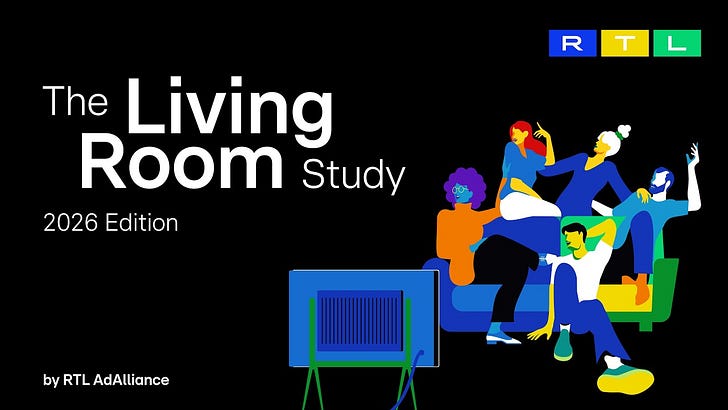
The RTL AdAlliance & Streaming Made Easy Living Room Study surveyed 15,000+ viewers across 17 countries and the findings should end the lazy habit of transplanting US trends onto European markets. Co-viewing remains a defining habit across the continent, with families and households still gathering around the television in a way that mobile and social consumption simply does not replicate.
The structural differences are just as stark on the advertising side. France still routes 75% of its CTV ad impressions through a set-top box, as Emmanuelle Godard of Canal+ Brand Solutions made clear on our ad panel, while the rest of Europe sits closer to a 70/30 split in favour of smart TVs.
European broadcasters hold a genuine advantage in this environment. 50 years of editorial credibility, cultural trust and shared national moments are not something a global platform can manufacture through a licensing budget. But that advantage should not be a resting position. The broadcasters gaining ground are those embracing creator partnerships as audience acquisition strategies (not just content acquisition ones) and showing up natively on social platforms rather than using them as redirect mechanisms.
For more, download the report here or dig into past articles:

#2 - Commentary personalisation is the most underrated product feature in sports streaming.
MasOrange built the ability to swap the official broadcast commentary for a preferred radio commentator’s audio stream directly into their sports product. Uptake was high enough which means the official broadcast voice was never the draw, the game was. Platforms that understand this will stop treating commentary as a fixed layer and start treating it as a personalisation lever, one that costs almost nothing to implement and measurably deepens the fan relationship.
#3 - Advertising tolerance has done a full reversal.
Two years ago, 78% of subscribers said streaming should never carry ads. Today, 36% say they would accept double the ad load if it meant cheaper bills. The Bango subscriber study also points to ad-free becoming a minority tier by end of 2026. Subscribers are making rational trade-offs and the platforms still treating ad-supported as a second-class tier are misreading where their audience has already moved.
For more, download the report here or dig into past articles:


#4 - Honest consent unlocks CTV advertising.
CTV ad revenues grew 35% in France in 2025 against 18% growth in overall video instream. The growth is real but the infrastructure underneath it remains fragile. Fragmentation across set-top boxes and smart TV operating systems makes programmatic buying, frequency capping and attribution inconsistent across markets. The bigger problem is trust. The industry has relied on vague consent mechanisms to collect viewing data for years. Sharp’s Nick Ruczaj put it plainly: if platforms simply promised users they would not see the same ad more than five times in a given period, most people would opt in without hesitation. Users do not dislike ads, they dislike irrelevant, repeated ones. Honest data exchange, not sleight of hand, is what will unlock the CTV advertising opportunity at scale and SyncMint is on a mission to deliver on that opportunity.

#5 - Convenience is the best anti-piracy strategy in sports.
La Liga estimates it loses 700 million euros a year to piracy. No enforcement mechanism solves alone a problem that is fundamentally about friction. Fans turn to illegal streams because legitimate options are too fragmented, too expensive, or buried behind multiple subscriptions. The platforms winning in sports are the ones making it easier to watch legally than to find a pirate stream, through a stellar video viewing experience, better UX, smarter bundling and features that an illegal stream cannot replicate, including community tools, alternative commentary, multi-view and personalised experiences. MainStreaming degrades rather than blocks ultimately converting pirates into paying subscribers rather than playing whack-a-mole with VPNs and new connections.

#6 - Personalisation at sign-up is a retention lever, not a nice-to-have.
FX Digital and Dyn Media asked users to select their preferred sport at sign-up. Around 63% did and those who made that choice showed a 35% higher customer lifetime value than those who skipped it. One optional question at the start of the journey changed the retention curve measurably. The first 30 days remain the critical window: keep a user engaged through that period and they are far more likely to stay. The broader point applies across every streaming category. Personalisation from day one is not a product flourish, it is a business model decision.
#7 - Quality assurance is a revenue and retention strategy.
Streaming platforms systematically underinvest in testing relative to its impact on what actually matters. In e-commerce, research shows 39% of consumers never return to a retailer after a broken transaction. There is no evidence that streaming audiences are more forgiving. If the payment fails or the app crashes, viewers simply leave. With hundred of devices, market, language and payment combinations to support, no in-house QA team can cover the full surface area alone. That’s where Testlio’s crowd testers come in. The platforms that treat testing as a competitive advantage will pull ahead of those that only address quality problems after viewers have already gone.

#8 - Your metadata is failing your viewers, AI is picking up the slack.
The NLZIET and Media Distillery session showed what AI-powered navigation already looks like in practice: real-time chapter markers, topic segments and preview clips that get a viewer to the right moment in under 30 seconds. Discovery is not just a UX problem, it is a data quality problem and AI is solving it faster than anticipated.
During the Olympics, Media Distillery analysed audio and video in real time, identified sport discipline transitions and generated chapter markers that let viewers jump directly to ice skating, skiing or handball without scrubbing through four hours of broadcast. 15% of Olympic replay viewers used the feature and Sports content drove a 5x uplift in usage compared to the daily baseline.
#9 - AI is not coming for your content strategy but for your front door.
Multiple sessions converged on the same conclusion, approached from different angles. Bango’s subscriber study found that 40% of Gen Z respondents would hand full subscription management, including signing up, cancelling and switching tiers, to an AI agent. The closing panel named AI assistants as the most credible candidate to own the living room entry point within three to five years, not because anyone has built that product yet, but because the consumer behaviour pointing toward it is already measurable. Subscription fatigue, the rise of indirect acquisition channels and the chaos of managing >5 subscriptions across multiple billing relationships all create exactly the conditions that a well-designed AI intermediary would solve.
The threat this poses is specific. A platform that earns a direct relationship with its subscribers, through a great app, frictionless billing and personalised experience, retains that relationship when the AI layer arrives. A platform that brings friction and relies on habit to keep subscribers in place will find that an AI assistant removes both overnight. The question is not whether AI aggregation is coming but whether your product is good enough to survive being recommended rather than defaulted to.
10. Community rules
As always my tell tale (when it comes to measuring the success of an event): how the community engaged and felt throughout the show. I felt a surprisingly optimistic vibe amongst peers. Folks are being challenged but not discouraged.
See for yourself here.

What’s next
Over the next few weeks, The Media Odyssey Podcast will release:
→ a StreamTV Show Europe wrap up where Evan Shapiro and I got to spend time with Denis Ostir, Editor-in-chief at V (formerly known as Vidaa), who’s dead set on fixing the measurement’s hot mess we’re in by building an open measurement tool.
→ a fascinating conversation with Bogdan Nesvit, co-founder of Holywater Tech, where you’ll see I was spot on when it comes to the irrelevance of the pay as you go business model (see my bets for 2026) but maybe not so right on the quality of content produced.
That’s it for today but before you go: comment, likes or shares come a long way.
We hope to see you at our next Streaming Made Easy Live event in Amsterdam on September 10th, 2026. The tickets are now available here. Premium subscribers get 30% off so consider upgrading today.
Enjoy your week and see you next week for another edition of Streaming Made Easy!