

There is a lazy habit in our industry. Something shifts in the US market and within weeks it becomes a European strategy talking point. AVOD is booming, ad tiers are the future, Linear TV is dead. The data tells a different story and it has been telling it for four years, but most people were not reading the right study.
For the past four years, RTL AdAlliance’s The New Life of the Living Room report has tracked how Europeans actually watch, pay for and feel about video content. The 2022 edition started with 8,500+ respondents across 10 countries. By 2025, that had grown to 12,500+ respondents, 15 European markets, with the US added as a benchmark (back in 2024). The study earned its authority over time.
I went through all four editions to identify a few key trends (but do grab the reports for more) ahead of the release of the Th edition, which Streaming Made Easy is co-producing with RTL AdAlliance. It goes further than any previous iteration: 15,000+ respondents, 17 countries in 3 continents. Before we get there, here is what four years of data already tell us.
Today at a glance:
→ The US comparison trap
→ Broadcast still owns the first click
→ The ad-tier migration is speeding up
→ Trust is moving in one direction
→ What’s in store for 2026?
The US comparison trap
The 2024 edition introduced the US as a benchmark for the first time. Smart move and not because the markets are similar but because the data proved they are not.
Start with advertising: In the US, 22% of viewers said they actively pay attention to ads. In Europe, that number was 8%. Americans were almost three times more receptive. US viewers also showed far greater tolerance across every platform: ad annoyance on YouTube sat at 38% in the US versus 57% in Europe. On AVOD, 30% versus 41%.
The gap goes beyond attitudes toward ads. It showed up in which platforms people actually use. In the 2025 study, 38% of US respondents watched FAST content on their TV set daily. In Europe, that figure is 10%. YouTube on the TV set hit 53% daily usage in the US versus 30% in Europe.
Churn tells the same story. 53% of US respondents admitted to churning SVOD subscriptions (subscribing for a show, then cancelling). In Europe, that dropped to 37%. Americans treat subscriptions like rentals while Europeans treat them more like utilities. The 2023 edition showed what happens when Europeans do face budget pressure: 48% preferred dropping a subscription entirely rather than switching to a cheaper ad-supported plan (28%). They cancel, they do not downgrade. That is a fundamentally different churn dynamic than the US subscribe-watch-cancel cycle and it has been consistent across multiple editions.
Content preferences diverge too. In 2024, the most-watched genre on European linear TV was news (30% of viewing). In the US, it is sport (22%). This shapes programming strategy, scheduling and ad placement for anyone operating across both regions.
42% of US households were willing to increase their video budget during 2024. In Europe, only 17% said the same.
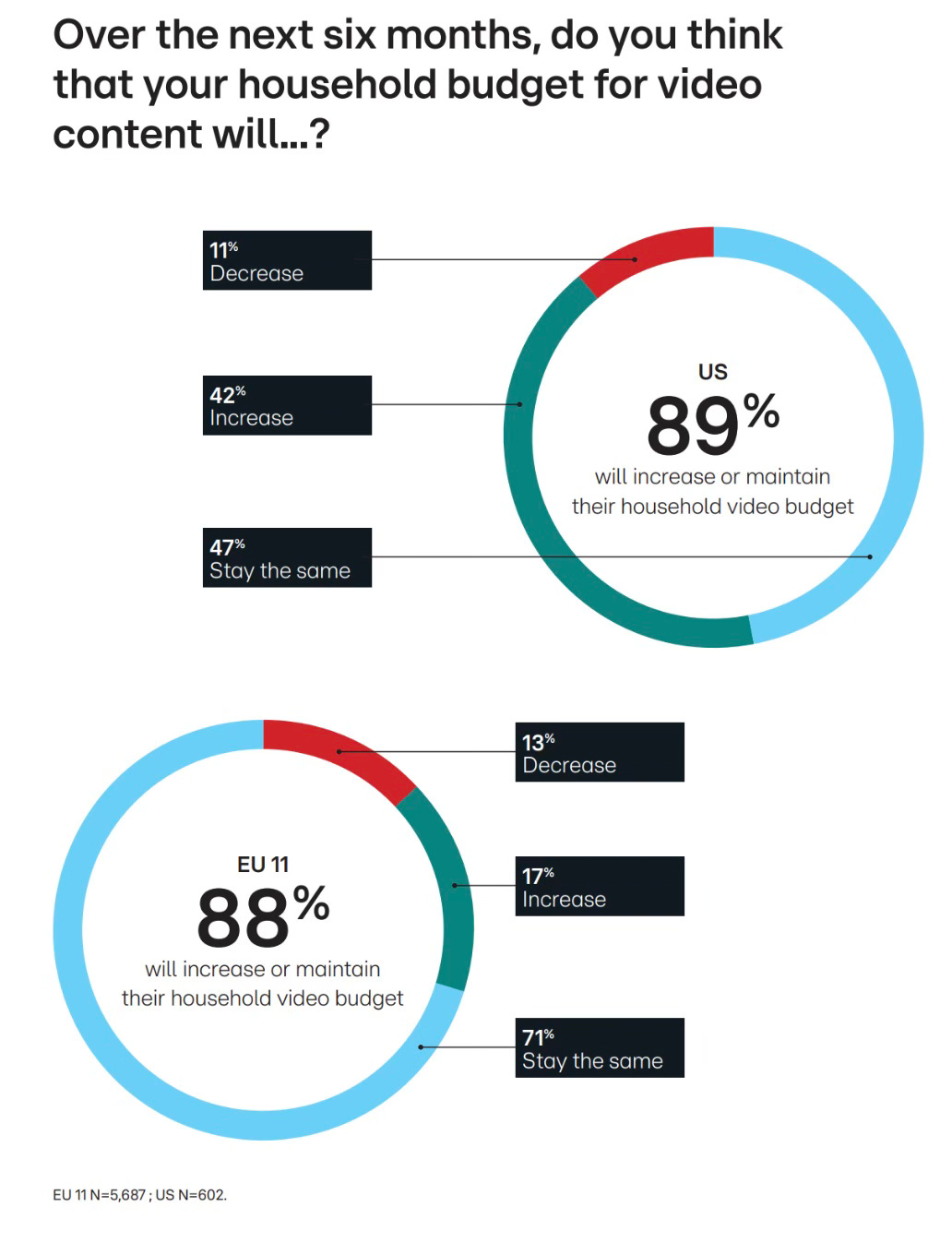
The takeaway is simple: US trends are directionally interesting. They are operationally misleading for anyone planning a European launch, campaign or content strategy.

Broadcast still owns the 1st click
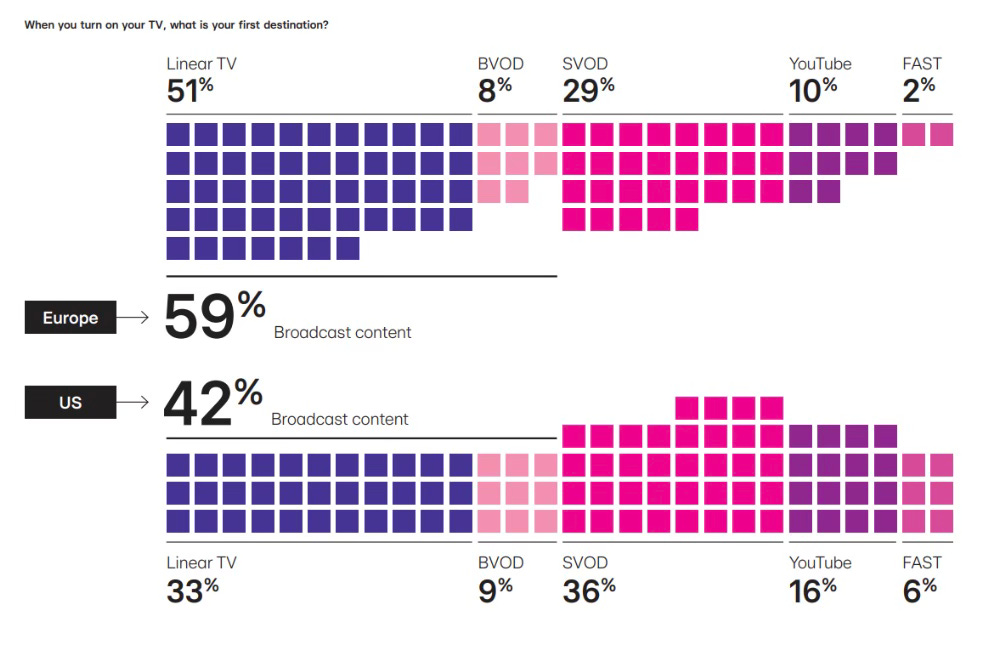
The 2025 report asked: “when you turn on your TV, where do you go first?”
59% of European viewers go to broadcast content first when they turn on their TV. That is linear TV (51%) plus BVOD (8%), ahead of SVOD (29%), YouTube (10%) and FAST (2%).
The same study mapped genre preferences by platform. Linear TV led for news (59% of viewers watched it there), sport (44%) and entertainment (44%). SVOD dominated only one category: movies and series, at 63%. The genres that drove daily habit, the ones people build their evenings around, still belonged to broadcast (which explains partnerships like the Netflix / TF1 one or Netflix’s content investment into daily soaps like Valle Salvaje with RTVE or Tout pour la lumiere with TF1 and Newen Studios).
When asked to define what counts as “watching TV”, the study shows that the lines of the definition are blurring for viewers, as their opinions differ widely. What stands out is that “watching TV” is perceived as a mix of device, platform and content type. While half of European respondents consider watching long-form content on YouTube via their TV set as “watching TV”, only 22% feel the same about user-generated content (UGC).
The discovery problem that needs fixing
The 2025 study measured how long it takes European viewers to decide what to watch. The results were not flattering for on-demand platforms. 24% of SVOD users spend more than 10 minutes choosing a programme. On YouTube, that drops to 19%. On linear TV, just 15%. Flip it around: 40% of linear TV viewers decide in under a minute. On SVOD, only 22% do.
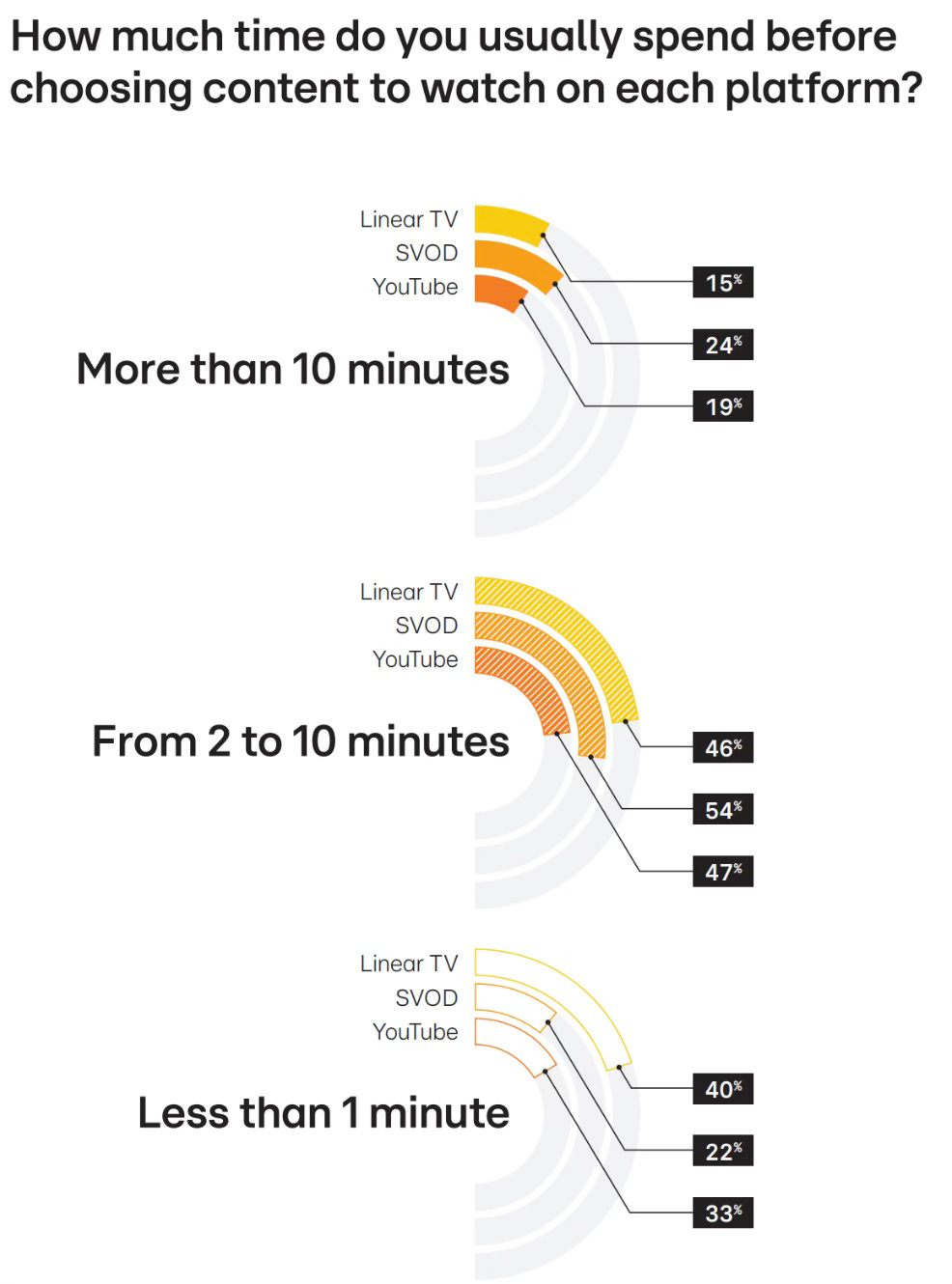
The reasons matter because SVOD viewers have high expectations for their evening. They are paying for the service and they do not want to waste their time on the wrong pick, which creates a kind of paralysis that linear TV sidesteps entirely by removing the choice. You turn it on and something is already playing.
YouTube has a different problem. 32% of viewers who watch YouTube on their TV admit the content hooks them but they often regret the time spent. That is not a discovery issue but a satisfaction issue: the algorithm is too good at keeping you watching and not good enough at making you feel like the time was well spent.
For platforms and content owners, this is more than a UX complaint. Discovery friction drives churn and decreasing engagement. If subscribers spend 10 minutes browsing and still feel unsure, that frustration compounds over time. The next wave of competitive advantage in streaming will not come from who has the biggest library but from who helps viewers find what they want before the mood passes.
The ad-tier migration
In 2023, the Living Room study captured Europeans at a crossroads. 58% said they preferred to pay for ad-free viewing. 56% said they did not mind ads if it meant free or cheaper access to premium content and 52% agreed with both statements at the same time. That contradiction is the European ad-tier market in one number. Viewers want premium content without ads but they will accept ads if the price is right. The question was always which instinct would win as budgets tightened.
By the 2024 edition, the compromise was gaining ground. 23% of Europeans were switching to cheaper or ad-supported services. Awareness of Netflix’s ad tier (launched late 2022) reached 62% across the five largest European markets. Disney+ trailed at 48%, partly because its ad tier launched a year later. But intent remained low: only 9% of European respondents said they would “definitely” subscribe to Netflix with ads. 56% said they were not bothered by advertising if it meant cheaper access to premium content, well below the 78% in the US.
Then came 2025 where the switch rate jumped to 29%, up 6 points in a single year. That is faster than any prior shift in this study.
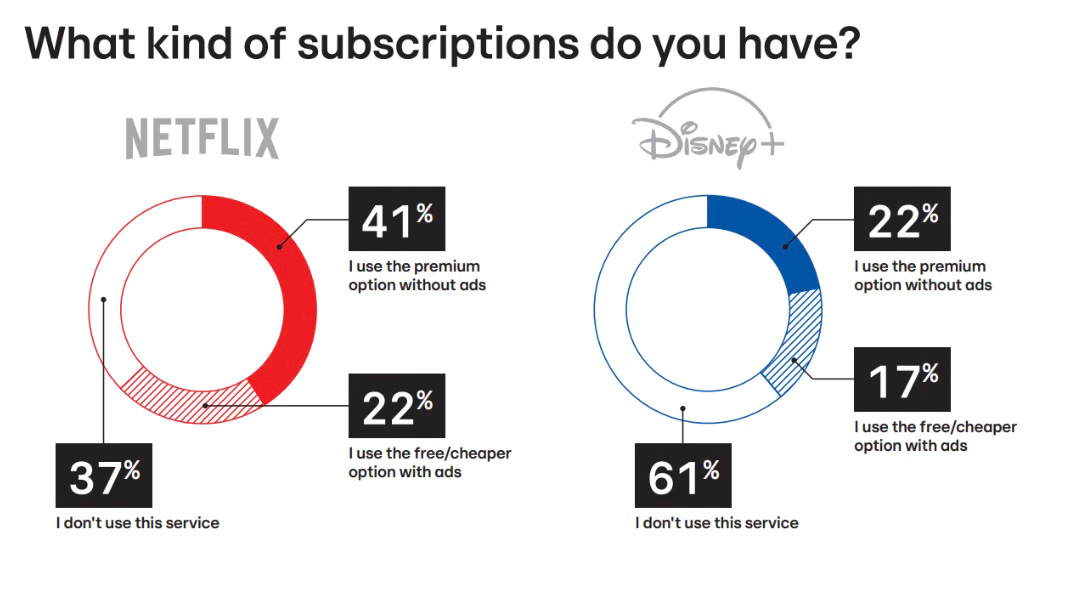
What changed? Budget pressure, yes but also normalisation. The 2023 data showed that only 14% of Europeans were “definitely” interested in Netflix with ads. In 2025, 22% of European respondents use Netflix’s ad-supported tier, while 41% pay for the ad-free option. Intent underestimated reality. Once the option existed and the price gap became visible, viewers moved.
📆 Sign up to attend the upcoming RTL AdAlliance & Streaming Made Easy webinar taking place in March 23rd, 2026, where we will unpack the 5th edition of The Living Room report.
The trust gap keeps widening
Between 2024 and 2025, every legacy media format gained 5 to 6 trust points when Europeans were asked whether they would trust a brand they did not know after seeing or hearing an ad. Radio now leads at 67% (+6pts); Linear TV follows at 66% (+6pts); Cinema at 65% (+5pts); Magazines and newspapers at 64% (+6pts).
The 2025 edition is the first to measure trust across this full spectrum, from legacy media down to individual social platforms: TikTok sits at 23%, Facebook at 31%, Instagram at 34% and YouTube at 41%.
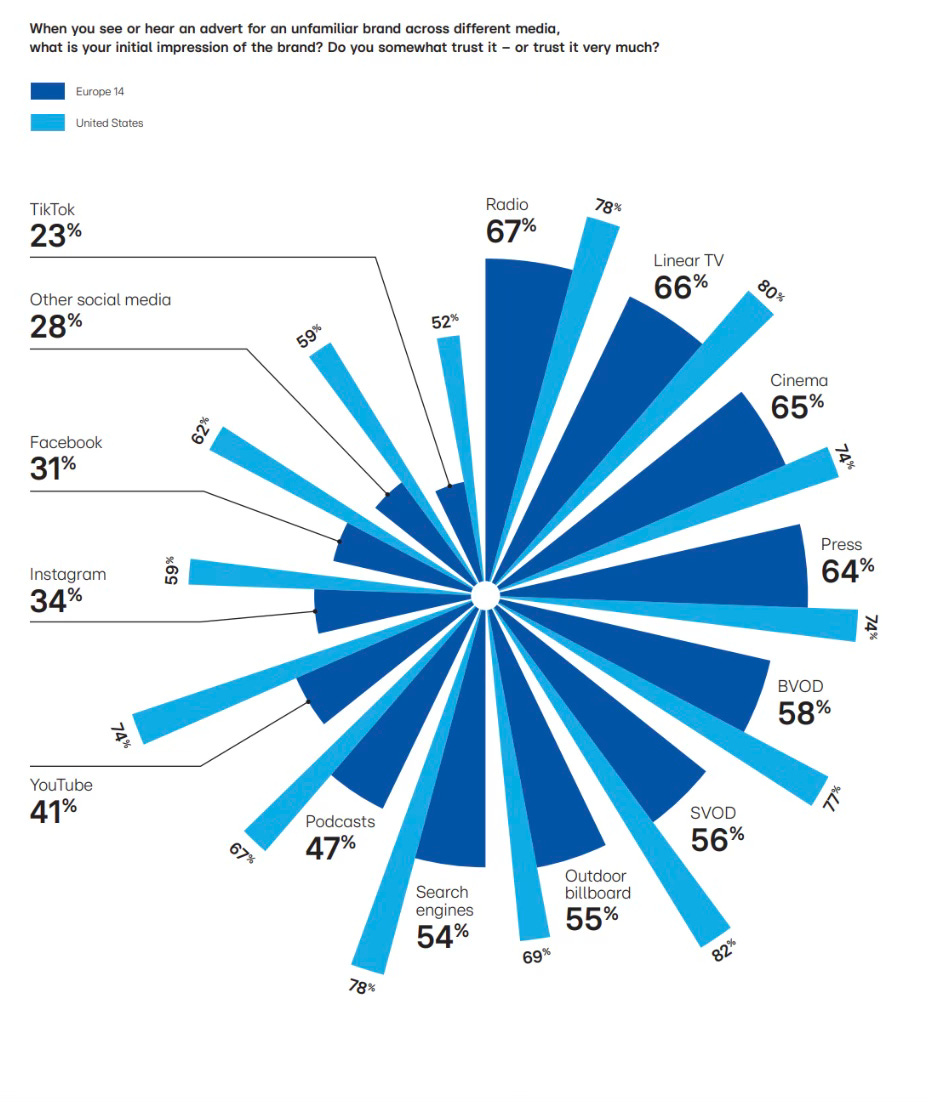
In a world where disinformation erodes audience confidence daily, where brands place their ads is becoming a brand equity decision, not just a reach calculation. Affordable impressions on low-trust platforms are not affordable if they damage how your audience perceives you. European viewers are telling us, clearly and consistently, that they trust professional content environments over social feeds.
The data also reinforces something European broadcasters should shout louder about their ad environments being premium. 57% of European viewers expect ads on linear TV to be fun, 54% expect them to be moving and 67% expect them to be informative. No other platform comes close to those expectations. Viewers are not just tolerating ads on linear TV, they hold them to a higher standard because they value the environment they appear in.
What’s in store for 2026?
The 5th edition goes wider. China and Hungary join the study bringing the total to 17 countries and 15,000+ respondents. That matters because benchmarking European ad tolerance and media trust against markets with fundamentally different media environments, state involvement in broadcasting and social platform landscapes will sharpen arguments that currently rely on the US as the only external reference point.
For the first time, the study also examines how Europeans feel about being exposed to AI-generated video content, whether watching long-form through small clips is a trend and what Europeans like to watch on YouTube. These are not abstract themes, they connect directly to how you plan distribution, allocate ad spend and position your platform in 2026 and beyond.
RTL AdAlliance and Streaming Made Easy will be bringing a report for you to download, a live webinar to attend where Aurélie Brunet de Courssou and I will highlight what caught our attention the most. This is your opportunity to be in the know, don’t waste it.
Sign up to attend our upcoming webinar taking place in March 23rd, 2026.
Wanna brush off on past reports beforehand? Dig in: Living Room 2025; Living Room 2024; Living Room 2023; Living Room 2022.
🗳️ Poll time
That’s it for today. Comments, shares or likes come a long way 🙏🏻
Enjoy your week and see you on Thursday for another edition of Streaming Made Easy!
Such an insightful post Marion, and actually very uplifting for someone like me who's spent their life in European public media