
Bundle or be bundled
New Bango research, real European examples and an uncomfortable question: is your company building the bundle or disappearing inside someone else's?

The subscription economy is entering a new phase. For years, the playbook was simple: build a service, launch it direct-to-consumer, compete on content and/or price. That era is ending. What is replacing it is a market that divides into two camps: companies that bundle (and own the customer relationship, the billing, the interface) and companies that get bundled into someone else’s package (and lose control of all three).
New research from Bango, surveying 4,000 consumers across the US and UK in January 2026, puts hard numbers behind this shift. 61% of Brits now expect streaming services to be included within their internet, TV or phone package, not as a bonus but as a baseline expectation. 31% of Americans say they are done with standalone subscriptions entirely, a figure that rises to 48% among Gen Z. And 71% of British consumers say they are more loyal to telcos that help them save money on subscriptions.
The consumer verdict is in: whoever simplifies the subscription mess wins. The open question is who that “whoever” turns out to be because the candidates are not limited to the usual suspects. Retailers, neobanks, publishers and even creator-led brands are all making moves.
Today at a glance:
The squeeze
Those who bundle
Those who get bundled
The new wildcards
The squeeze
The pressure to bundle is hitting every part of the European media and telecom ecosystem at once.
On the streaming side, fragmentation has reached its natural limit. European households juggle an average of 3.2 subscriptions (vs 4.5 in the US and 3.5 in LATAM) and after years of price hikes, consumers are consolidating rather than adding blindly. Smaller SVOD services have already become add-on channels inside aggregators. For streamers who lack the scale of a Netflix or Disney+, the question is no longer “how do I grow directly” but “which bundle do I need to be inside to grow the most.”
On the telecom side, Europe is consolidating toward three operators per country. According to Analysys Mason, 56% of Europeans live in a three-MNO market by end of 2025, up from 46% a decade earlier. When connectivity commoditises, differentiation moves upstream to whoever controls the bundle, the billing and the discovery layer.
European broadcasters feel it too. Partnerships with former rivals (Netflix with TF1, France Televisions with Amazon, Disney+ with ITV, Atresmedia and ZDF, RTL with Sky) are multiplying because doing it alone is no longer viable. These deals are bundling strategies in disguise: exclusivity traded for distribution reach.
And here is the demand signal that should worry everyone: Bango’s earlier European research found that 19% of subscribers across the UK, France, Germany, Spain and Italy use pirate streaming as their only way to get content in one place.

Those who bundle
The companies winning this race share one trait: they control the interface (and underneath the billing relationship) between the consumer and the content.
Sky’s February 2026 move is the clearest example. Netflix, Disney+, HBO Max and Hayu packaged into a single TV subscription from 24 pounds a month, with genuine Sky OS integration: unified recommendations, cross-app Continue Watching and voice search that spans every service.
Canal+ runs a similar play in France with Apple TV and Paramount+ included for all subscribers. Deutsche Telekom is scaling operator-led Disney+ bundles across its European footprint starting with Hungary.
CTV platforms are playing the same game from a slightly different angle. Samsung, LG and others control the home screen (but often lag behind on the payment layer), which in a bundle economy is arguably the most valuable real estate in streaming. These platforms now operate their own FAST channels, ad sales and subscription storefronts. For any streamer without Netflix-level scale, home screen visibility is an existential question.
Those who get bundled
Paul Larbey, CEO of Bango, puts it bluntly: “if telcos do not move quickly to become the orchestrators of subscription access, they risk being reduced to a product inside someone else’s experience.”
That warning extends beyond telcos. For content providers, getting included in a Sky or Deutsche Telekom bundle delivers scaled distribution and lower acquisition costs. But someone else owns the customer relationship and in some cases the product fades in the background leaving only content as the driver (often without the appropriate service brand attribution). Bango’s research found that 30% of US SVOD subscriptions were sold through indirect channels. The services that optimise for indirect distribution will reach more subscribers. Those that insist on owning every customer relationship directly will watch their addressable market shrink.
The new wildcards
What makes this moment different is the range of players entering from outside media and telecom.
Neobanks like Revolut, which launched a mobile network in the UK in January 2026 offering unlimited 5G for 12.50 pounds a month, could bundle subscriptions next.
Retailers have been testing similar plays. In France, Carrefour piloted a bundle in early 2024 offering customers Netflix Standard with Ads alongside a 10% discount on own-brand products for 5.99 euros a month in Bordeaux and Rouen (but no national roll out ensued). In the US, Walmart+ includes Paramount+ and Peacock and Kroger Boost offers Disney+ Basic.
Publishers are testing the logic too. In France, Le Monde and Telerama launched a bundle with WBD’s HBO Max in April 2025, folding streaming inside a journalism subscription. The logic works because it serves the same consumer need: consolidate, simplify, reduce.
Then prominent creators like MrBeast, with 471 million followers, who is planning to launch Beast Mobile and acquired fintech app Step, positioning himself as the GenZ bundler.
The direction is clear: any company with a recurring billing relationship and/or a large customer base or following can position itself as a bundler. The boundaries are dissolving and the only question that matters is who the customer trusts the most to be their default subscription hub.
That’s it for today.
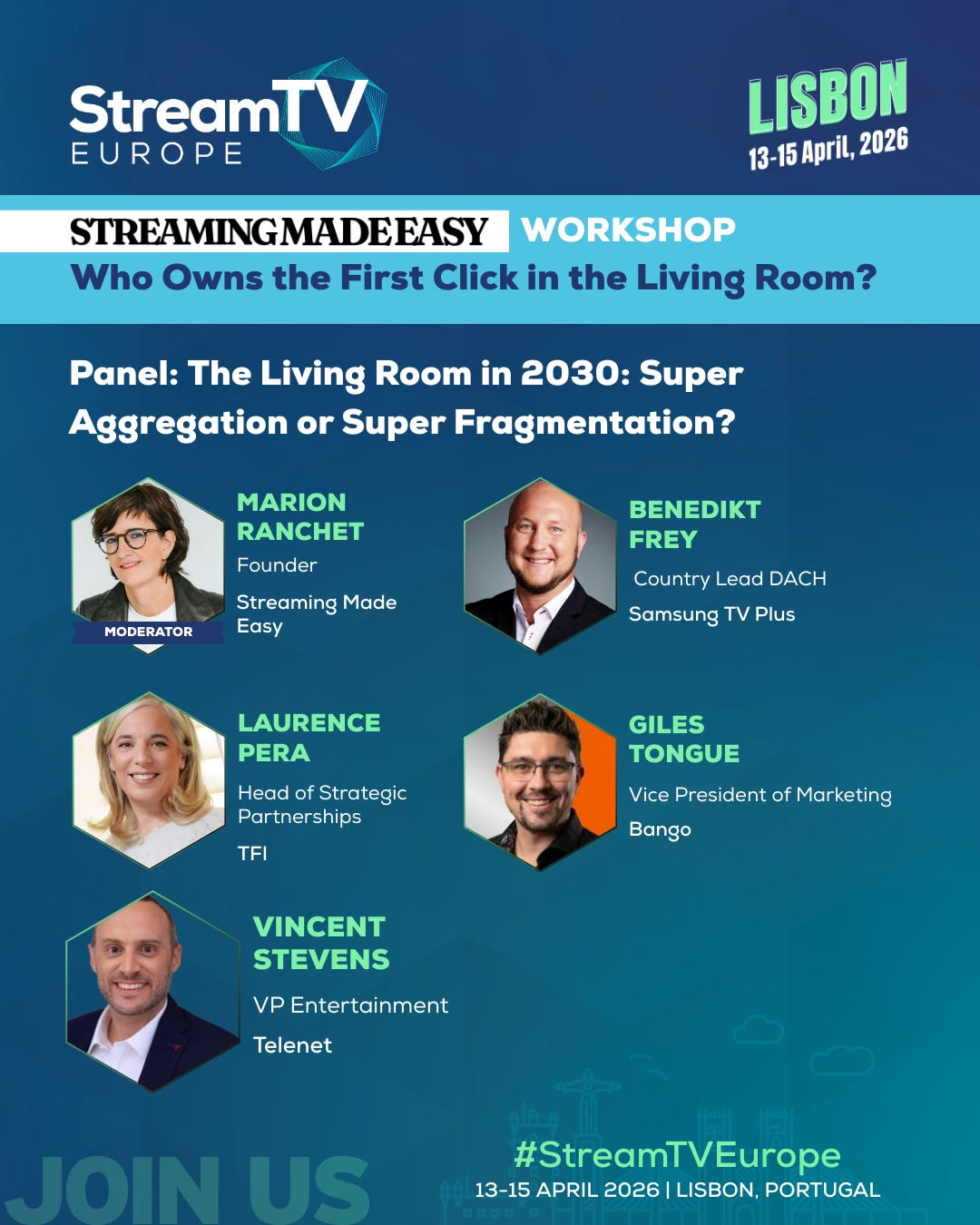
During Streaming Made Easy Live - Lisbon, Giles Tongue, Bango’s Chief Marketing Officer, will join our panel ‘The Living Room in 2030: Super Aggregation or Super Fragmentation?’ where we will discuss what happens by 2030? Will one player own the living room or will we still be switching between apps, juggling subscriptions and forgetting passwords?
Join us at StreamTV Europe. Use my code (SME10) to get 10% off here. We just released our programming here. A lot of great content is coming your way.
🗳️ Poll time
That’s it for today. Comments, shares or likes come a long way 🙏🏻
Enjoy your week and see you on Thursday for another edition of Streaming Made Easy!