

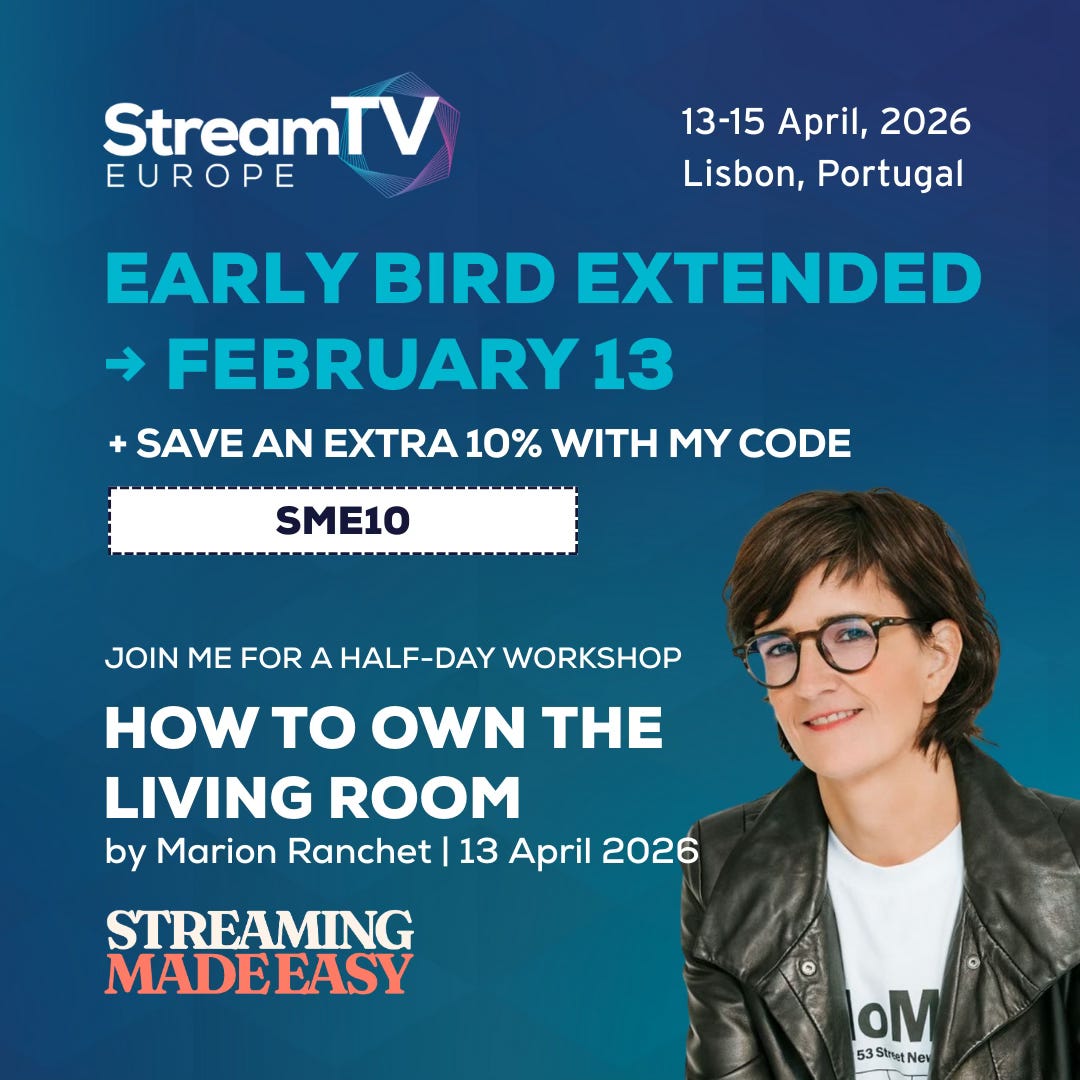
🇵🇹 My case as to why you should join me at #StreamTVEurope
This one is built differently. Built for Europe. For its beautiful messiness, its multilingualism, its regulatory vigilance and its refusal to be like anywhere else. You'll find the people actually building platforms and negotiating partnerships across the region.
Alan Wolk and I are kicking things off on April 13th, a morning programming designed to get your brain firing without overwhelming you at 9 AM:
→ The largest annual study of European viewing behaviour, benchmarked against the US, China & Saudi Arabia.
→ Broadcasters and telcos, not just Big Tech.
→ Fragmentation strategies, not just siloed playbooks.
Pedro Bandeira, Jorge Graça, Luis Lopes, Andreas Waltenspiel, Bernd Riefler, Côme FRADETAL, Laurence Pera, Giles Tongue, Mehmet Eroglu, Pieter Oonk, Sara Mariotti, Sabrina Simone, Tom Smith, Vitoria Steimetz, Jo Redfern 🔜 MIPLONDON, Maria Rua Aguete, Jonathan Broughton, Carine Jean-Jean, Jean-Baptiste Moggio, Aurélie Brunet de Courssou, Tobias Pfalzgraff, and many more operators who live this every day.
If you care about where European streaming, CTV, FAST and advertising are actually heading, StreamTV Show Europe is where that conversation happens.
EARLY BIRD PRICING ENDS ON FEB. 13TH. You're welcome for the extra week, procrastinators 😉 My code gets you an EXTRA 10% OFF: https://lnkd.in/ed2M9yBV

🍰 The premium layer hiding under Roku’s free funnel
Everyone is framing The Roku Channel as a FAST/AVOD success story. That framing is incomplete. The Roku Channel now accounts for 3% of all US TV viewing, a level only reached by YouTube, Netflix, Disney's services and Prime Video. Most analyses reduce Roku’s rise in Nielsen’s Gauge to “Free TV momentum”. But that success comes from Roku’s ability to monetise the same attention across advertising and subscriptions.
Roku is rebuilding the bundle from the bottom up by collapsing free and paid viewing into a single, continuous journey. Inside Roku, viewers move from free linear channels to on-demand titles and into premium add-ons without ever leaving Roku’s UX, billing or recommendation environment, which allows Roku to stack ad yield and subscription revenue on the same viewing time. Roku is not just capturing ad dollars, it is positioning itself upstream of monetisation decisions.
If your Roku strategy stops at FAST/AVOD distribution, you are only playing the top of the funnel. I unpack this premium layer in the latest edition of Streaming Made Easy, including the 72 subscription services on Roku, pricing logic, gaps and more.
Grab the article here and the infographic there.
📊 Earnings season, no PR spin
This week Evan Shapiro and I went live across LinkedIn and Substack to break down Google and Disney’s earnings, you were 100+ joining us, thank you!
→ Google crushed expectations everywhere except YouTube, which grew single-digit only. Evan’s theory on why? The money moved. Cloud up 48%, Gemini at 750M monthly active users and could Google be the only big tech company that actually understands AI?
→ Disney handed Bob Iger’s mess to Josh D’Amaro, the parks guy. Streaming finally hit profitability but the Fox acquisition still has them $60 billion underwater.
The spiciest moment: Evan and I argued live about what Nielsen’s Gauge actually measures inside the Roku Channel. If you know the answer, the comments are open.
Watch the full episode wherever you get your podcasts or catch the replay here (we start at the 2’37” mark!).
👉🏻 APPLE PODCASTS | SPOTIFY | YOUTUBE | DEEZER with more platforms here.
Join us live on February 12th at 5pm CET for our next earnings session with Amazon, Roblox in the mix happening on LinkedIn and Substack.
📺 From rival to revenue stream
Broadcasters’ sales houses’ discourse about YouTube will start changing when they finally see big bucks coming from the platform. And just like on Linear TV, representing third-party inventories is the quickest way to that goal.
ITV just expanded its YouTube sales operation by partnering with Banijay Rights and Banijay UK, adding shows like Would I Lie To You?, Peaky Blinders, MasterChef and Jimmy Carr’s stand-up to its advertising roster. This builds on ITV’s strategic partnership with YouTube announced in December 2024, where ITV’s commercial team started selling the full range of YouTube advertising opportunities.
What makes this interesting is the logic. Broadcasters spent years treating YouTube as the enemy, then as a necessary evil and now as a monetisation channel they can control. ITV is betting that brands want curated, brand-safe environments and that broadcast sales teams know how to sell premium inventory better than YouTube’s self-serve platform. Banijay’s YouTube network pulled in over 10 billion views globally last year. How did ITV’s UK views and ad impressions perform in 2025? Find out here.
📡 Samsung becomes the set-top box
Are set top boxes done and dusted? No. Could they disappear? Yes, just like streaming dongles. As Connected TVs get smarter, the need for an external device to be plugged into a TV becomes redundant. Telcos need to prepare themselves for a device-agnostic world where the customer relationship can no longer be tied to an own and operated box.
Just this week, OSN just launched TVkey Cloud across 20+ Middle East and North Africa markets, putting its full Pay TV service directly onto Samsung CTVs. No box, no hassle, just linear satellite channels streaming through the TV’s chipset.
What makes this different from every other TV app? OSNtv becomes the primary live TV source, not just another icon lost in the app grid. The TV is the box. The operator stays in control.
“With the launch of TVkey Cloud, OSN is adopting innovative solutions that go beyond traditional set-top boxes to drive growth, expand service reach, and monetise content,” said Morten Solbakken, Executive Vice President and COO, NAGRAVISION.
Read more about the technology behind this launch and grab my infographic here about the latest European moves in the space.
⚖️ Who owns the truth?
BARB’s departing CEO, Justin Sampson, just published a response (in The Media Leader) to what he calls “the recent events” and lays out four choices the industry faces about the future of audience measurement. Each one forces a decision between collective discipline and unilateral control, between shared standards and proprietary convenience, between markets that function and markets that break.
BARB’s argument is simple: You can’t demand equivalence in commercial impact while resisting equivalence in scrutiny. When the most powerful players get to choose their own metrics and police how others understand them, trust collapses and markets fragment.
The four choices Sampson outlines “will determine whether audience measurement continues to serve the whole ecosystem or becomes something narrower, noisier and partisan.”
Read the full piece.
🗳️ Poll time
That’s it for today. Enjoy your weekend and see you on Tuesday for a Deep Dive edition of Streaming Made Easy Premium.