

TikTok shows you something in two seconds and you either want more or you don't. Your streaming app shows you a grid of thumbnails and wishes you luck.
Tom Smith has spent years thinking about this. As Co-Founder and Creative Director of FX Digital, the London-based CTV studio behind streaming and broadcast apps for clients across Europe and North America (incl. Odido, Britbox, Discovery+, Dyn, Eurosport, Channel 4), Smith sits at the intersection of viewer behaviour and product design. When I asked him what’s landing on his desk right now, here’s what he said:
“There’s a lot of hype around AI and conversational search but the biggest request is still discoverability.”
The irony is that social media already cracked this. The format itself is the discovery mechanism: no title card, no genre label, no star rating, just a hook and your gut reaction to it. Could that behavioural logic be migrating from your phone to your television? Let's find out.
Today at a glance:
The two-way scramble
The Blockbuster UI problem
Social is Gen Z’s Home Screen
What this looks like in a product
The two-way scramble
Social media platforms want a piece of the big screen. Premium streaming apps are worried that social media is eating their viewing time period. Both sides are building into the other’s territory as a result.
TikTok launched a TV app on Samsung Smart TVs in Europe in December 2020, then expanded to North America in late 2021, though it never gained meaningful traction on the big screen. YouTube Shorts has been on TV since 2022. Last fall, Instagram launched Reels Channels on Amazon Fire TV, organising short-form content into topic-based feeds designed for lean-back co-viewing rather than solo scrolling. The research backing that decision is telling:
“When they (Instagram) were researching the application, users were saying that actually watching Reels is a fun, enjoyable, collective engagement, which you wouldn’t think initially. You’d think it’s quite a private feed.”
On the streaming side, Disney+ has launched vertical content and Netflix is moving toward short-form video. Neither company is trying to become TikTok. What they’re trying to do is solve the same discovery problem their home screens have failed to solve for years, by letting the content speak for itself rather than asking viewers to judge a show by its thumbnail. “TV was first and then video became on mobile,” Smith told me. “Now mobile has invented their new format and TV’s learning from that. The two are kind of feeding into one another.”
Disney uploaded the entire High School Musical film to TikTok as 52 sequential short clips to mark the film's 20th anniversary. The campaign accumulated 34.9 million views across all 52 parts. It was a genuinely terrible way to watch a film (if you ask me but what do I know, I’m the oldest millennial, yep turning 46 in June), deliberately fragmented, black bars on both sides. And yet it worked, because the algorithm rewarded sustained engagement and fed each clip to anyone who watched even one. The lesson is not that people want to watch films in 52 pieces. The lesson is that short-form distribution functions as a discovery engine in a way that a static thumbnail grid simply cannot and that premium streaming services are only beginning to use it deliberately.

The Blockbuster UI problem
Which brings us back to the home screen. “It’s quite boring navigating through a home screen of solid images,” Smith said. “It’s like the Blockbuster of UI.” Walking into a Blockbuster was an overwhelming, often paralysing experience. Too many covers, too little context, not enough signal to make a decision. So you’d grab something familiar or surrender to a genre shelf and pick something at random (or better yet ask the staff). The modern streaming home screen reproduces that exact dynamic with higher resolution thumbnails.
Short-form video rails are one answer to this because they replace the passive artwork with an active hook. Instead of asking a viewer to evaluate a static image, they show a moment from the content itself and let the viewer’s instinctive reaction do the work. That’s not a new idea, Netflix has been doing it for years.
The challenge though? Hardware. A 2022 TV handles those previews differently than a current-generation device. “If you can’t replicate the speed of navigating through the assets, it loses its magic,” Smith said. The hook that works on mobile requires loading speeds and auto-play performance that older connected TV hardware often can’t deliver and that hardware fragmentation is pronounced across the world. Platforms are beginning to deploy AI-driven auto-reframe tools that optimize content simultaneously for mobile and CTV, keeping subjects centered and resolution high across both formats. But the speed problem remains a real constraint for any studio trying to replicate the frictionless feel of a social feed on older devices.
Social is Gen Z's Home Screen
FX Digital’s own research tracked how Gen Z actually finds content: “We found that Gen Z are more likely to use social media posts and discussions to find a TV programme that they want to watch: 68% versus 52% for millennials.”
Nearly seven in ten of the youngest and most commercially attractive viewers are discovering what to watch next through social feeds, before they open a streaming app. The discovery journey doesn’t start on the home screen but on Instagram, TikTok or YouTube and once they open the app, the home screen is essentially just a search confirmation step.
Smith connects that behavioural shift to how short-form content hooks work in practice. “They don’t have short attention spans because we know that they watch 24-hour streams, they’re watching hour-long podcasts. But when they’re in that mode of short form content, the hook has to be there quickly.”
What this looks like in a product
So what does a short-form discovery rail actually look like inside a streaming app on a TV, when it’s done well?
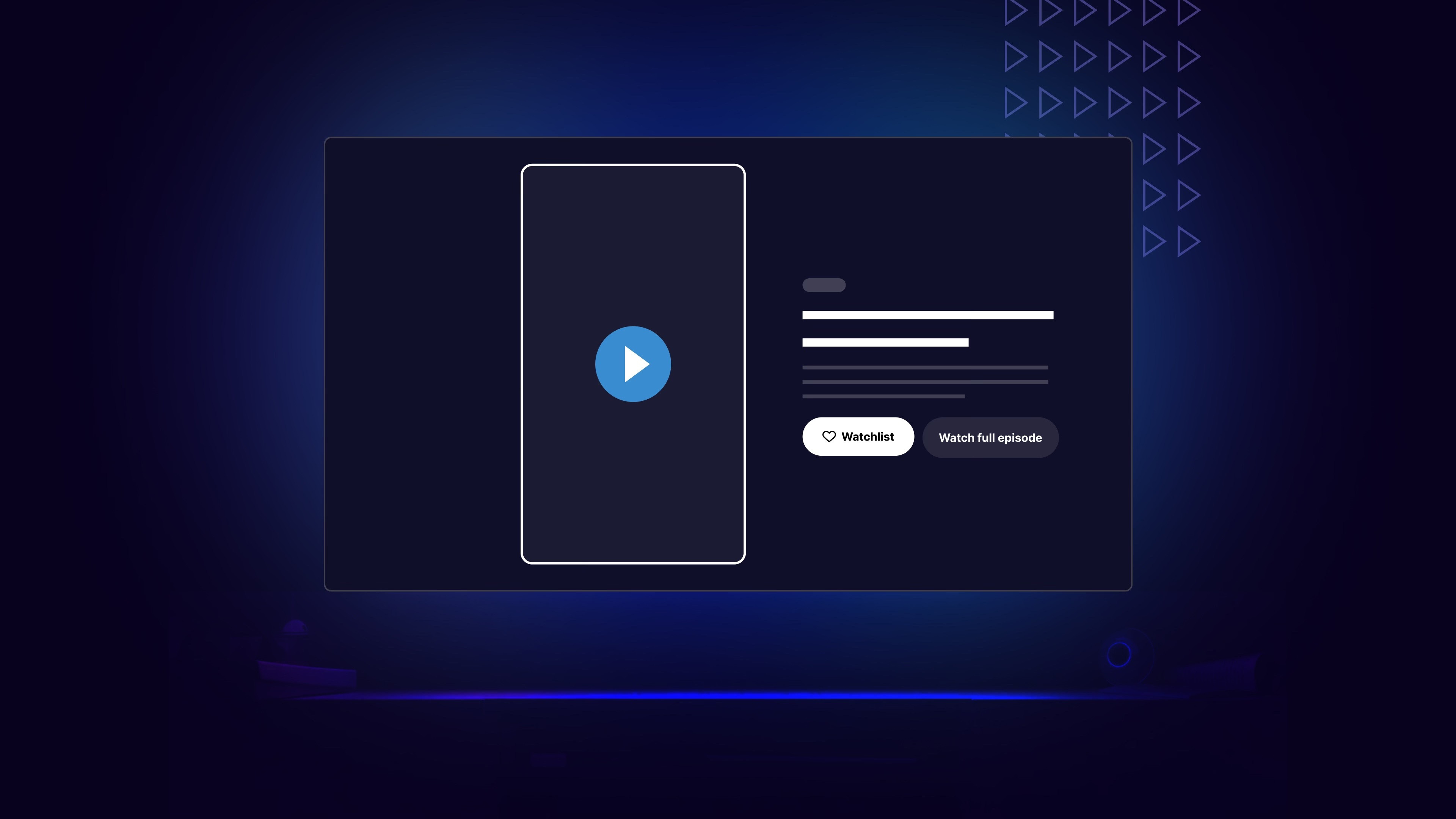
Smith is clear that it shouldn’t be a direct replica of the 9/16 TikTok experience. The goal is not a new format for its own sake but it’s a better answer to the question every streaming viewer asks every night when it’s time to choose something to watch. “I don’t see the big streamers wanting to clone a social media app,” he said, “but I think they’re realizing that short form assets is an incredible way to engage with an audience. So why can’t we take those learnings from social media and apply them to our viewing experience?”
In practice, that starts with editorial decisions at the content level, before you touch the interface at all. The asset itself needs reediting. “It’s the storytelling and the editing that actually makes them most engaging,” Smith told me. “It’s about picking the emotional beats or the hooks from the asset that have those high points.” Reality television works particularly well because the dramatic peaks are short, self-contained and punchy. A confrontation from a competition show can land in two seconds but a scene from a prestige drama generally cannot and trying to force it into that format produces something that serves neither the format nor the show.
The sidebar around a vertical asset becomes useful for actions, watch now, add to list, share, rather than more content. The experience needs to communicate intent immediately because unlike a social feed where users arrive in exploration mode with low commitment, streaming app users often come with something specific in mind. A short-form rail has to earn the right to interrupt that intent by being genuinely useful as a discovery tool, not just visually novel.
There is also a longer-term argument here that goes beyond discovery. “They’re gonna capture far more behavioral data about the user’s experience on the short form content,” Smith said. “What is hooking, what’s engaging, what are they swiping through and that is gonna build up recommendation engines that you’re gonna see on the TV.” The short-form surface is not just a feature, it could be a signal-gathering mechanism that feeds the main recommendation engine and that’s where the real strategic value could compound over time.
Smith is honest about this trend: “We don’t really have enough data on bringing vertical into those apps to know whether it’s going to stick.”
That’s it for today but before you go:
During Streaming Made Easy Live - Lisbon at StreamTV Europe, Tom Smith will present how FX Digital delivered a CTV app for Dyn Media and its 20 Million alternative sports fans.
Join us at StreamTV Europe. Use my code (SME10) to get 10% off here. Our full programming is here. A lot of great content is coming your way.
🗳️ Poll time
That’s it for today. Comments, shares or likes come a long way 🙏🏻
Enjoy your week and see you on Thursday for another edition of Streaming Made Easy!
Don't miss out this research by the FX Digital team: https://fxdigital.typeform.com/sme-2025?typeform-source=www.linkedin.com