

📊 Signal vs. Noise: The Report
The media industry just had its most transformative year in a decade. Did you catch the signal or just hear the noise?
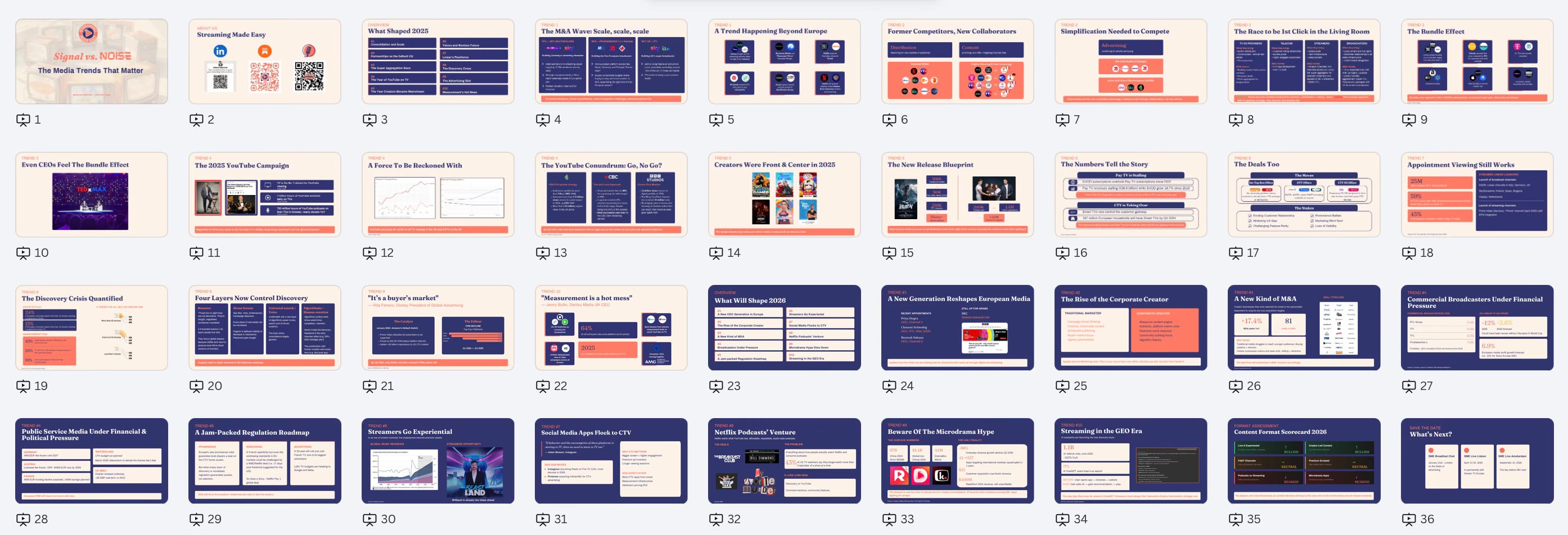
Introducing our inaugural Streaming Made Easy report: “Signal vs. Noise: The Media Trends That Matter”.
What’s in the report?
→ The 2025 scorecard: 10 trends that reshaped streaming, TV, and advertising — from the M&A wave to the discovery crisis — with the data behind each shift.
→ The 2026 playbook: 10 predictions on where the market is heading, including new CEO leadership, creator M&A, regulation flashpoints and the rise of AI-driven discovery.
→ Format conviction calls: A bullish/bearish assessment of live experiences, creator content, FAST, podcasts on streaming, micro dramas and more.
Who is it for? C-suite, strategy leads, business development and anyone shaping a media company’s strategy over the next 12-18 months.
It’s not just a report, it’s an opportunity to spark a conversation amongst peers. I was lucky to premiere this report in a live session last week at Osborne Clarke in front of 100+ lawyers from all corners of the industry (DAZN, WBD, Netflix, ITV and many more were in attendance).
I will be on the road with this format (ping me if you want me to stop by your company) and in the interest of building conversations with our SME Premium subscribers, I will be presenting the report in an upcoming premium subscriber-only webinar taking place on February 3rd, 2026 at 5.30pm CET / 3.30pm EST / 8.30am PST. It’s a live-only webinar so make sure to come.
Upgrade today, attend our webinar, try out our premium tier for a month and decide if we’re a keeper.

📺 Telly’s trillion-dollar math problem
Telly, the free TV startup that promised to ship 500,000 ad-supported TVs by the end of 2023 and “millions more” in 2024, has just 35,000 sets in homes. That’s according to a leaked Q3 2025 investor update obtained by Janko Roettgers’ Lowpass. The gap between promise and delivery is staggering: 250,000 preorders, 35,000 fulfilled.
Surprising considering that these TVs are free. You can indeed order one via Telly’s website and here comes a free TV. Simple enough? Maybe not. According to Roettgers, a brutal 10% of TVs shipped via FedEx arrived broken. Reddit is littered with photos of shattered screens, some from replacement units. Telly has since switched logistics partners but the damage (literal and reputational) is done.
Here’s where it gets interesting. Despite the tiny install base, Telly hit $22 million in annualized revenue. Could the second screen model, a constant ad ticker under your TV, actually work? Roettgers did the ARPU maths.
Where the maths gets tricky is Pozin ambitioning to be a trillion-dollar company like Apple and Tesla. The company has raised $350 million in debt. At 35,000 units, that’s $10,000 in debt per TV in the field. Trillion-dollar company energy this is not.
🤝Gorgeous glass, rented operating system
Sony and TCL just signed a memorandum of understanding to create a joint venture for Sony’s home entertainment business. TCL takes 51%, Sony keeps 49%. The new entity handles everything: product development, manufacturing, sales, logistics, customer service. Target launch: April 2027.
Why now? Why this pair?
These two already know each other. TCL manufactures and sells LCD panels to Sony through its China Star Optoelectronics subsidiary. This deal deepens the relationship considerably.
What does Sony get? Access to TCL’s vertically integrated manufacturing chain. TCL controls production from raw materials to finished product, which lets them move faster on new display technologies and keep costs low. Sony’s image processing is legendary, but their cost structure is not. This partnership fixes that.
What does TCL get? The secret sauce. What makes a Sony TV a Sony TV isn’t the assembly. It’s the system-on-chip and image processing capabilities. Sony has led the industry in picture quality for decades. TCL gets to learn from the best.
The deeper question: in a world where the OS layer and ad monetization matter more than the glass, what about the operating system of these newly Sony-TCL TVs? Sony runs Google TV. TCL splits its lineup between Google TV, Roku and its own TCL Channel interface. Neither company owns its OS layer. In a world where the real margin lives in software, advertising and data monetization, this joint venture might be building beautiful hardware that prints money for Google and Roku instead of themselves.
🇪🇺 ARTE’s quiet public service media empire expands
ARTE just added Dutch public broadcaster NPO to its European partner network, bringing the coalition to 14 members.
The deal is straightforward: co-productions, editorial exchange, shared creative resources. NPO gets access to European distribution for Dutch stories. ARTE gets fresh content and another flag on the map. The network now spans from Portugal to Ukraine, Finland to Italy.
What makes this interesting is the timing. NPO Chair Jet de Ranitz explicitly cited “a challenging budget environment” as motivation. Translation: public broadcasters across Europe are getting squeezed and going it alone is no longer viable. ARTE offers scale without surrender. You keep your identity, your audience, your editorial control. You gain co-production muscle and continental reach.
Fourteen partners, no equity swaps, no mergers, just collaboration with contracts. Sometimes the unsexy model is the one that actually works.
📉 Netflix’s hidden engagement problem
Netflix posted a monster Q4: 325 million subscribers, revenue up 16% for the year, net income up 26%. Wall Street expected less. The stock still dropped 7%.
Why? Because the number that matter is slipping.
Netflix reported 96 billion viewing hours in H2 2025, up from 95 billion the prior half. That’s 1% growth. Do the math on a per-subscriber basis and you get roughly:
1.7 hours per sub per day.
Last year, it was 1.8.
In 2023 it peaked at 2.2.
The direction is clear. More subscribers, less engagement per head.
Netflix knows this. That’s why they stopped reporting subscriber numbers, then suddenly brought them back when they had good news. That’s why they’re chasing Warner Bros so aggressively. Library content drives daily engagement. Friends, Game of Thrones, Succession: these are the shows people leave on while cooking dinner. Netflix doesn’t have enough of them.
The ad business tells a similar story. $1.5 billion in annualised revenue sounds impressive until you realise it’s roughly 3% of total revenue. They want to double it this year and triple it by 2027. But without engagement growth, ad inventory stays flat (unless you boost the ad load). You can’t sell more ads if people aren’t watching more.
Ted Sarandos keeps saying there’s “so much room to grow.” He never explains how. The Warner deal is one of the answers they’re not saying out loud: they need other people’s content to keep their subscribers engaged.
→ Listen or watch the full breakdown of Netflix’s Q4 earnings on The Media Odyssey Podcast.
→ Next up: Apple & Meta on January 30th 4pm CET / 10am EST / 7am PST. It’s a live episode (on our YouTube channel) so bring your questions.
🗳️ Poll time
That’s it for today. Enjoy your weekend and see you on Tuesday for a Deep Dive edition of Streaming Made Easy Premium.