

CES wasn’t in the cards for me this year but in the end snow > the Strip.


Amazing people covered the show like Andy Beach's Engines of Change, Janko Roettgers’s Lowpass or Alan Wolk’s TVREV so let me focus instead on what happened outside of CES. Off we go.
🎤Meet your 1st speakers
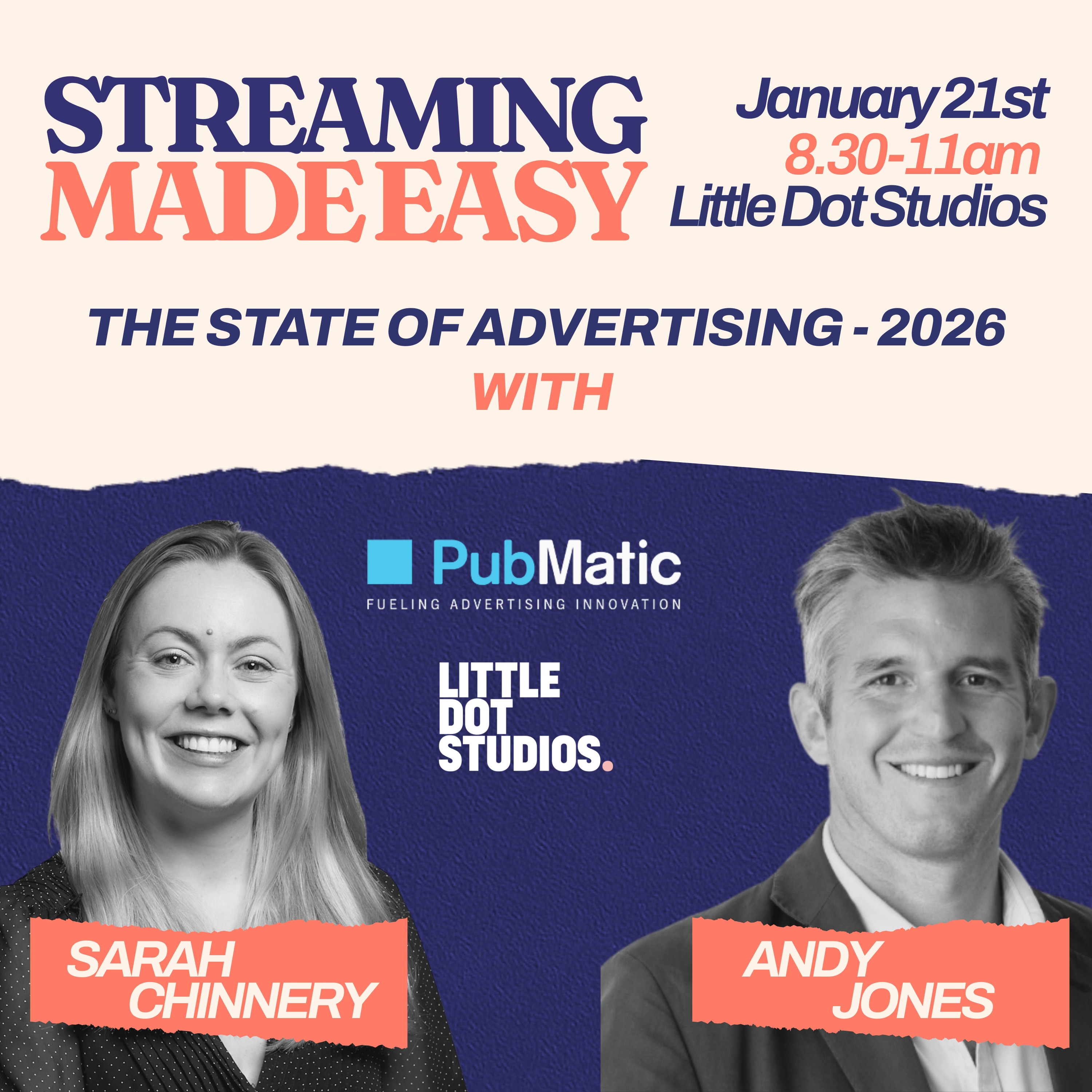
On January 21st, 2026, I’ll get to spend time with Andy Jones (VP Broadcast & CTV EMEA) from Pubmatic and Sarah Chinnery (Head of Advertising Partnerships) from Little Dot Studios, who both bring a ton of knowledge about the state of the ad business in 2026. I have two additional speakers in the works with complementary perspectives.
Discover fellow companies attending: PubMatic, SkyShowtime, Disney+, Prime Video, ITV Studios / Zoo55, BBC Studios, Samsung, TiVo, Crunchyroll, Sony, National Theater, Channel 4, StreamTV Show, All3Media International, Netflix, Moments Lab, Animate and Create, MARV, Bango, Teads, Samsung Ads, Titan OS, Futrhood, Crescent Communications, Sky News, Publicis Media (PMX Lift), Roseberry, Red Bee, Amazon, Liberty Global, Hearst Networks, FX Digital, Roku, Streemfire, Electrify, T&P WPP, Yospace, Google, PGW Marketing Ltd, Citywire, RakutenTV, Newshore partners, Wubble, Accelerate Consulting, Insight tv, NBCUNIVERSAL etc.
Registration happening here.

🇩🇪 HBO Max finds its German wingman
HBO Max launches in the DACH region on January 13. This week, they announced a bundle with RTL+, the market leader with 7 million subscribers. Pricing starts at €9.99/month for the first six months. The combo brings Game of Thrones prequel A Knight of the Seven Kingdoms, The White Lotus and The Last of Us alongside RTL+ local hits and Europa League football.
This is textbook market entry. When you launch in Europe’s second biggest M&E market, you partner with the local commercial broadcaster. You borrow their brand credibility, you tap into their installed base and you skip the cold start. RTL+ gets premium Hollywood content to upsell subscribers. HBO Max gets 7 million warm leads instead of starting from zero. Both protect their business against churn, like Disney+ or Telenet before them.
Going solo in Europe is expensive and slow, going together is smarter and faster.
🏟️ 75 million households, zero bidding wars
Sports Studio Inc. signed 7 global distribution deals for its Free Live Sports platform, extending reach to 75 million households. The partners include VIDAA (Hisense), Rakuten TV, Titan OS, Whale TV, Anoki and Swift TV. They also inked a deal with 3SS for in-car entertainment.
This is the playbook: embed yourself into every smart TV operating system you can find. No bidding wars or rights fees eating margins. Just scale, ads and sports that travel well across borders.
🎮 Magnite wants gaming’s ad pipes
Magnite announced two gaming deals this week. Together they reveal a clear strategy: become the ad infrastructure layer for gaming across every screen.
First, Magnite partnered with PHȲND, a cloud gaming platform that streams console-quality games directly to Smart TVs: no downloads, no console, no subscription, just ads. Magnite’s SpringServe ad server will power both direct and programmatic sales. Advertisers can target by demographics, interests and play behaviour. This positions ad-supported cloud gaming as a new extension of the CTV advertising market. Same screen, same buyers, same programmatic pipes.
Second, Magnite became the global ad partner for Roblox’s Rewarded Video format. The numbers here are staggering. Roblox reaches 151 million daily active users who spend an average of 2.8 hours per day on the platform. That is deeper engagement than most streaming services can dream of. And it skews heavily Gen Z, the audience brands cannot find on linear TV. Rewarded Video works because it is opt-in: players watch ads voluntarily to unlock in-game rewards. Revenue flows back to Roblox creators.
Two deals, two screens (TV and mobile), one strategy. Magnite already dominates streaming ad tech. Now they are treating gaming inventory the same way. If gaming cracks the living room at scale, it starts competing for the same ad dollars as streaming.
Evan Shapīro and I don't agree on the whole YouTube is TV debate but here's something we can both get behind: we want to know what you think about the pod.
Take the annual survey here and tell us who should we have on? What topics make you hit skip? Where do you actually listen? What would make this your favorite media podcast? Tell us. We're listening.
Thank you for being along for the ride ❤️
🎄The biggest Free Streaming bet you missed
Deutsche Telekom discreetly launched FAST channels on Magenta TV in December with four channels from Mainstream Media AG (KultKrimi, Telenovela ZDF, World of Freesports and Filmgold), two more from Sportdigital (Scooore, Landlust TV). The target is to have 40 FAST channels by the time the 2026 World Cup starts.
You know I’ve been bullish about Telcos getting into Free streaming and this is the biggest launch we’ve had in Europe so far and yet I’ve read little about it.
It’s the biggest launch because DT is strong of 4.725M TV subscribers in Germany (according to their Q3 2025 earnings) but beyond adding FAST channels to their portfolio, it’s a big deal because they open their advertising inventory for programmatic buying for the first time in partnership with Equativ across the entire channel line up.
Telcos and platforms across Europe should all be racing to build free tiers before the World Cup lands. The logic is simple: free is the new front door. Whoever owns the free tier gets a shot at retaining and upgrading customers when ready.
⚽ DAZN ordered to play on in Belgium
Belgium’s arbitration body CEPANI ruled that DAZN must keep broadcasting Pro League football through the end of the 2025/26 season. The ruling came after DAZN tried to walk away from its contract, arguing it could not secure financially viable distribution deals with major telcos Proximus and Telenet.
DAZN had already withheld its November payment, triggering the league’s legal action. Under the interim measures, DAZN must resume €6.6 million monthly payments, continue production and broadcast services, and maintain anti-piracy commitments. The penalty for non-compliance: €50,000 per day.
This is the ugly side of the D2C sports bet. DAZN bought rights expecting telco distribution. The telcos said no thanks at those prices. Suddenly you are running an OTT-only play in a market where most fans expect football on their cable box. The math stopped working. DAZN still claims the contract ended lawfully and expects to win on the merits. But they are stuck producing and paying while arbitration plays out. That is a brutal cash burn.
For rights holders, this is a cautionary tale (again). Pure-play streamers can offer big numbers. But if they cannot crack telco distribution in Europe, that five-year deal might not last two.
🎙️The AI bubble, pocket TV and the extinction of ad free viewers
Year two of The Media Odyssey Podcast starts now!
Evan Shapiro and I started the first episode of 2026 the only way we know how: light banter, then predictions. Predictions are cheap I know but the arguments aren’t so have a listen. Full episode available here: APPLE PODCASTS | SPOTIFY | YOUTUBE.
🇫🇷 A 1992 law just cost French TV its 2nd biggest advertiser
Lidl France, the country’s second largest advertiser (and the 6th retailer), announced it will no longer invest in Linear TV. The reason: a 30-year-old regulation.
‘We will no longer invest in linear TV [traditional television] as long as the regulatory risks are too high, as is the case today,’ announced Jassine Ouali, Executive Director of Customer Relations at Lidl France.
In July, the Paris Court of Appeal ordered Lidl to pay €43M to Intermarché for violating a 1992 decree that allows retailers to advertise on TV. The issue: Lidl failed to guarantee product availability (of the discounted products they promoted) for 15 weeks, as required by law. The court found that 374 spots broadcast between 2017 and 2023 qualified as illegal promotions.
According to Stratégies, 22% of Lidl’s ad spend went to French TV last year (Lidl spent 400M€ in advertising during the 1st 9 months). That money will now be heading to Google, Meta and co.
But this is not just about dodging fines. The strategic case for leaving was likely building anyway:
→ French TV audiences are aging (in 2023 the average age was 57).
→ Lidl’s discount shoppers skew younger (their core target is women between 30 and 50 years old).
→ Finally, Lidl wants to refocus its image on low prices, as its Irish chairman, John Paul Scally, reiterated in September 2025.
M6 president David Larramendy failed to calm the situation, calling the court ruling “obsolete, incomprehensible and unjustifiable”. Lidl is out or at least ready to be out until regulatory changes take place. The French Ministry of Culture mentioned the launch of a study for ‘a possible amendment to the regulations’.
European broadcasters are already fighting for ad budgets against global digital players. The last thing they need is regulation designed for a completely different media landscape pushing major advertisers out the door.
🗳️ Poll time
That’s it for today. Enjoy your weekend and see you on Tuesday for a Deep Dive edition of Streaming Made Easy Premium.
The timing matters here because this is a perfect model for where Gen Alpha's heading. They prefer to grind rather than whale. They'll invest time for rewards, not just open wallets for shortcuts. Rewarded video fits that behavior exactly—watch an ad, get in-game currency, keep playing. No extraction loop because they collaborate against it
Cloud streaming and pixel streaming have matured significantly and the tech is in far better shape than it was even two years ago (I learned this the hard way). Magnite's positioning across PHȲND's Smart TV platform and Roblox's mobile dominance puts them exactly where the infrastructure meets the audience over the next five years.
But Magnite will have to leg this one out. They can't treat it like mobile game activity expecting quick returns. This is an infrastructure build, not performance marketing. Hopefully they're not optimizing for launch week - it's about building sustained engagement that compounds over years.
Cloud gaming goes from $9.7B to $121.7B by 2032. That curve hits right when Gen Alpha gains direct spending power and the tech can actually deliver console-quality experiences without downloads or hardware barriers.