

Subscription fatigue is the dominant feeling in 2026. Streaming bundles get repackaged, ad tiers proliferate, password crackdowns continue, even social media wants you on a recurring plan. The category looks saturated and familiar which is why most of the industry could easily file Cineville as just “another subscription product.”
Cineville is a different beast in the landscape of subscription businesses we usually discuss here. The economics, the ownership structure and the relationship with the cinemas and the film distributors operate on a whole different level. After 16 years in operation, expansion across 5 markets, 158,000 members, more than 3.3 million annual visits, it has earned a proper look from Streaming Made Easy. The numbers behind its 16-year run tell a fascinating subscription story: retention through a pandemic, frequency that beats national averages and a demographic shift that any media business would die for.
Today at a glance:
Where Cineville comes from
The track record across five markets and counting
What the model has done to cinema in Europe
The role Cineville plays with movie distributors, not just exhibitors
What streaming can learn from Cineville
Shout out to Guillaume Branders who taught me all things Cineville in record time!
Not a premium subscriber yet? This is a good one to upgrade for. Premium subscriptions make this level of research and writing possible.
Where Cineville comes from
The story most people tell about Cineville (me included until I wrote today’s piece) is that it is a Dutch arthouse subscription card. The architecture underneath is what actually makes them stand out from the usual movie subscription pack.
In 2009, four students at Amsterdam’s Kriterion, a student-run cinema, walked into a near-empty arthouse screening and asked the question every European cinema operator has been asking for two decades: where are the young audiences? Their answer became Cineville, an unlimited card built specifically for independent and arthouse cinemas, launched the same year with a handful of Amsterdam cinemas.
The card is the visible part. Cineville BV actually operates as the platform layer, owning the technology stack, the brand framework, the expansion playbook and the advisory function for new markets. Each local Cineville is a separate legal entity, structured in some cases as a cooperative or an association, owned by the participating cinemas themselves. Cinemas vote on pricing, payout terms, marketing direction and expansion strategy, in coordination with Cineville BV.
Corporate cinema subscription cards (UGC Illimité in France, AMC Stubs A-List in the US, Cineworld Unlimited in the UK, Pathé in the Netherlands) are owned end-to-end by a single chain. The chain captures the subscription revenue, sets the pricing and owns the customer relationship. Cineville inverts that logic. The platform entity captures an operating share to fund expansion, infrastructure and editorial work then redistributes roughly 90% per visit back to member cinemas.

The track record across five markets and counting
Cineville now operates across five markets and is preparing two more European launches. Each market has stress-tested a different part of the structure and so far the structure has held. Across the five live markets, Cineville now has 158,000 members.
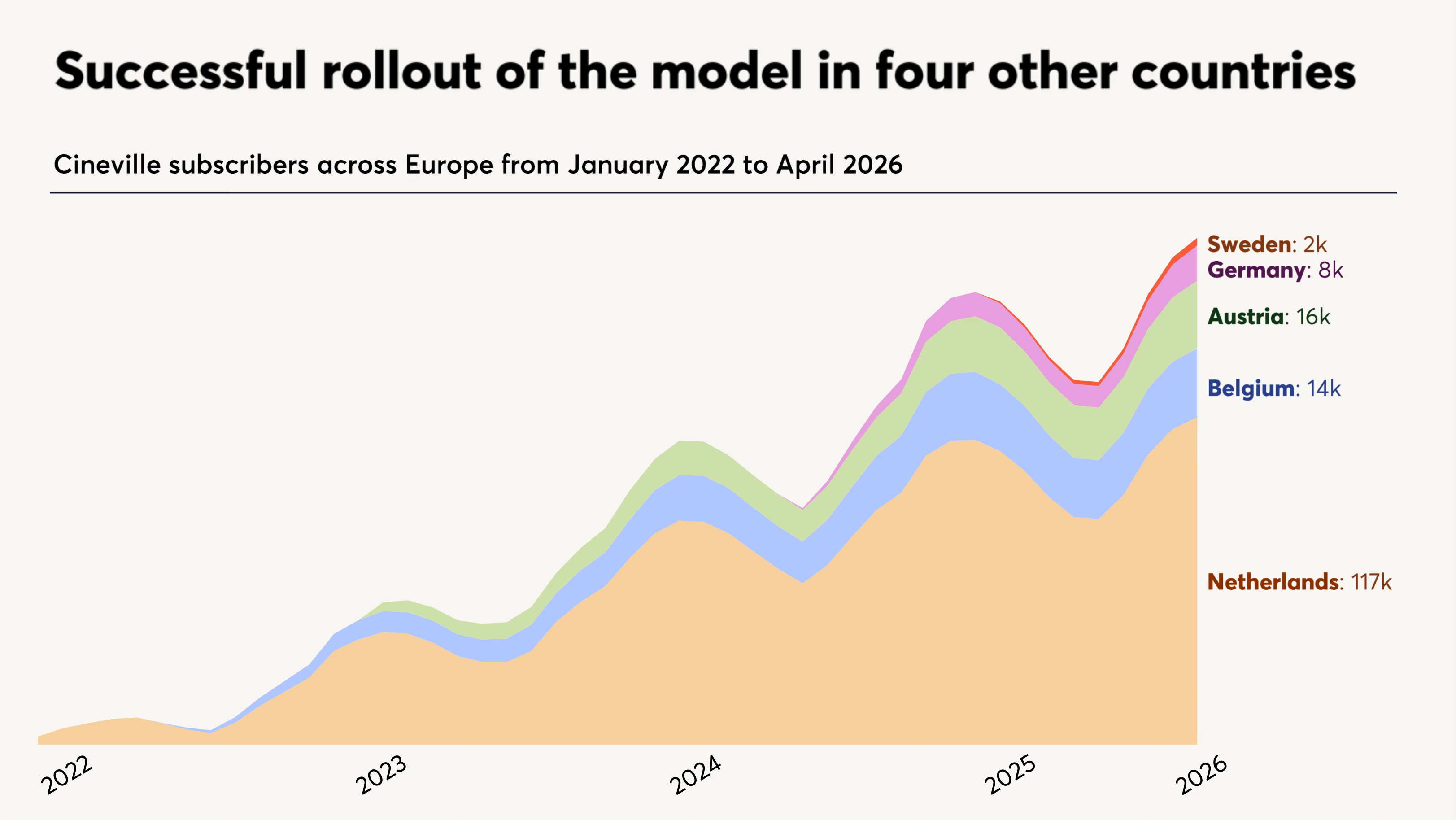
→ Cineville Netherlands got 117,000 subscribers which generated 2.5 million admissions last year (9% of total Dutch national cinema attendance according to a Cineville spokesperson). Two things stand out in the Dutch data.