


Nearly 8 in 10 Europeans spend at least 2 minutes choosing what to watch every time they sit down and for almost a quarter of them that search stretches beyond ten minutes, according to RTL AdAlliance's 2025 Living Room report. In the time it takes to find something to watch, viewers are returning to the home screen of both their Set Top Box, Connected TV and subscription platforms again and again. Samsung TV users, for example, visit the Samsung TV home screen five times a day on average.
In that window of indecision, the home screen owns them completely and every tile, banner and row on that screen is competing for the same moment of attention. This is the reality of streaming in 2026. Organic discovery still exists but it is shrinking fast as the sheer volume of content across platforms turns the home screen from a navigation tool into a marketplace. Banners, featured rows, dedicated hubs, contextual sports rails: all of it is up for grabs, all of it can be bought and crucially all of it can now be measured.
That is what this column is about.
Introducing Above The Fold
Above The Fold is a new column produced by Streaming Made Easy in partnership with Looper Insights, the leading CTV merchandising analytics platform. The company was founded in London in 2017 and built a dataset tracking how content and apps are promoted across 250+ CTV devices, including smart TVs, set top boxes, gaming consoles and streaming sticks, as well as 600 web stores across 120 markets. Their technology captures what viewers literally see on screen at any given moment, covering both paid and editorial placements. Their proprietary metric, MPV (Media Placement Value), measures visibility across paid, earned and algorithmic placements. $MPV converts that visibility into dollars while pMPV forecasts impressions. Together, they turn the home screen from a mystery into something measurable and actionable.
Above The Fold exists because visibility on the home screen is no longer accidental. Someone decided what you saw. This column looks at who, how and whether it worked. And what better way to kick off this column than with Peacock’s Legendary February!

Peacock’s Legendary February
On February 8, 2026, Super Bowl LX and the opening of the 2026 Milano Cortina Winter Olympics landed on the same day, with Olympic competition running through the day and the Super Bowl anchoring primetime. NBCU packaged it all under one brand, “Legendary February” and bet that Peacock could carry the weight of both.
The bet seems to have paid off. According to Nielsen, Super Bowl LX drew 125.6 million viewers across NBC, Peacock, Telemundo, NBC Sports Digital and NFL+ (unlike Tubi last year, we don’t know how many viewers Peacock garnered). On the subscriber side, Peacock added 968,000 new subscribers on Super Bowl Sunday alone, with 33% opting for the Premium Plus tier, more than double Peacock’s usual 14% share, according to Ampere Analysis. Churn the following day came in at 5%, less than half the 12% Paramount+ saw after its 2024 Olympics run.
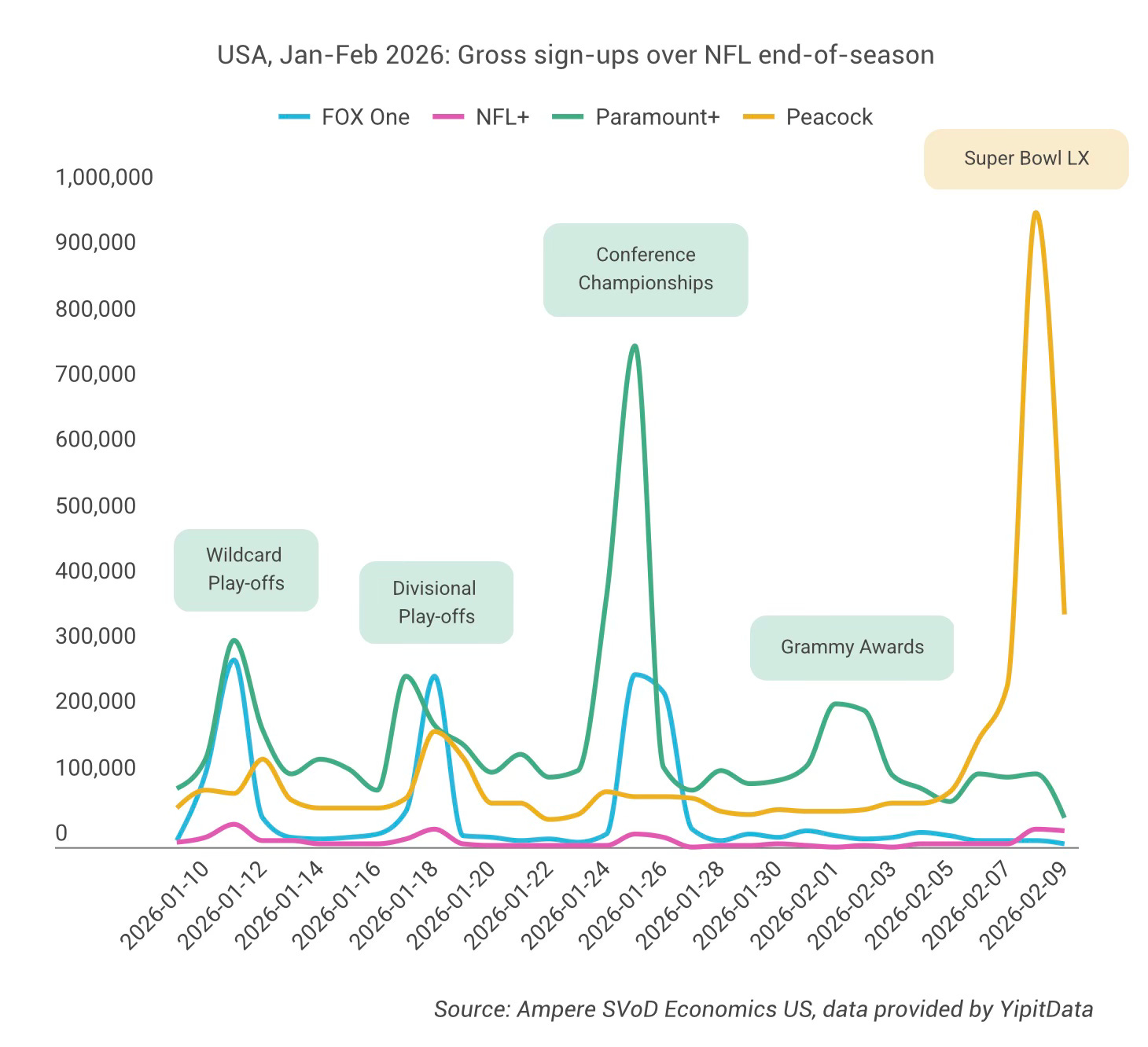
But the viewer and subscriber count only tells you the outcome. It does not tell you how viewers actually found their way to the content, which platforms delivered the most visibility or what the promotional effort was worth in measurable terms. That is where Looper Insights’ data comes in.
Game day on the Home Screen
I’ve asked the team at Looper Insights to track Peacock and NBC’s promotional activity across key CTV environments on February 8, focusing on homepage banners, featured rows, dedicated content hubs and promotional integrations.
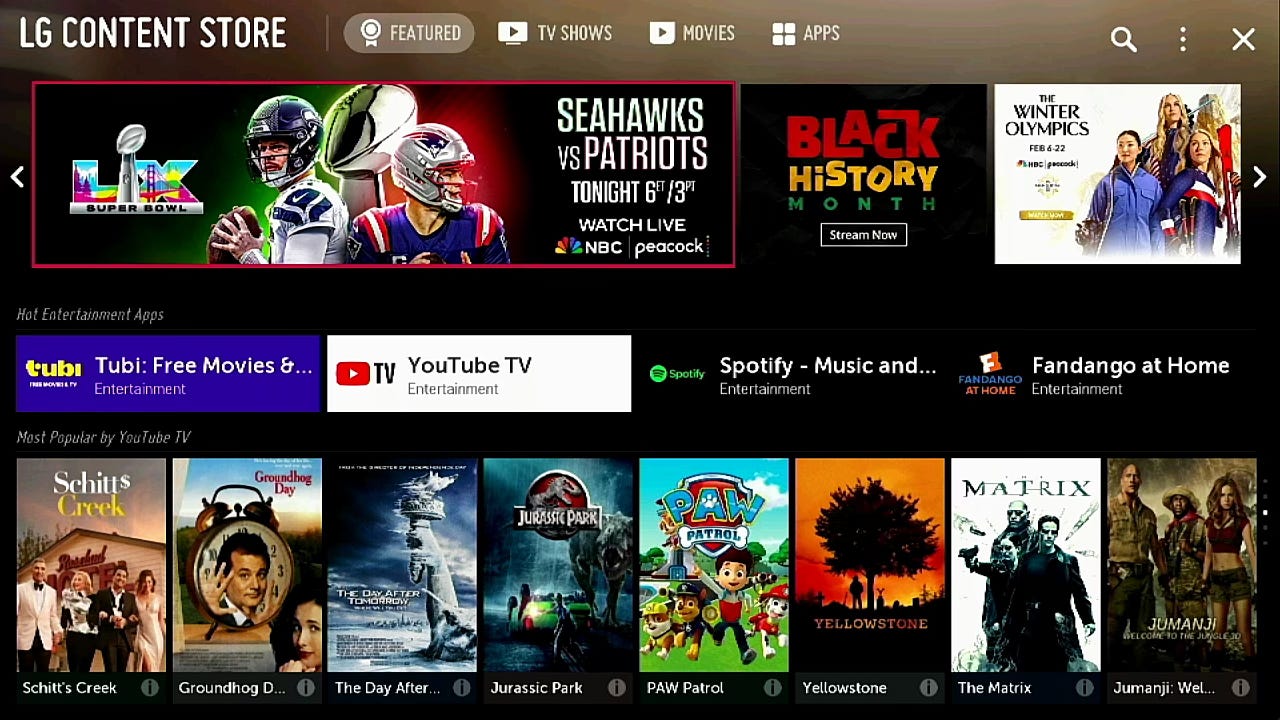
LG TV’s featured page placement used bold Seahawks vs. Patriots visuals, a prominent “Watch Live” CTA and clear time-zone messaging that removed any friction around tune-in.
DIRECTV positioned its banner above the live sports rows, exactly where viewers already hunting for live content are looking.
Xumo Charter went for the Sports page, landing the Super Bowl tile inside the “Live and Upcoming on Network TV” row where sports-native intent was already high and the audience was primed.
Outside the top three platforms, star power did its own work. With Bad Bunny confirmed as halftime headliner, several platforms leaned into music and entertainment angles to widen appeal well beyond traditional football audiences. They understood that February 8 was not just a game, it was a pop culture moment and they promoted it accordingly.
The campaigns’ visuals, placement values and impression data are in the Looper Insights report that you can download here.
Join us at Streaming Made Easy Live - Lisbon on April 13th during StreamTV Europe. Registration details here. Use my code (SME10) to get 10% off here.
We just released our programming here. A lot of great content is coming your way.
Seventeen days on the Home Screen
We then tracked Olympic promotion across key CTV platforms throughout the Games window, measuring which environments delivered the strongest visibility and what creative approaches drove viewers into NBC and Peacock’s content. The strategies varied significantly by platform and the results are detailed in full here.
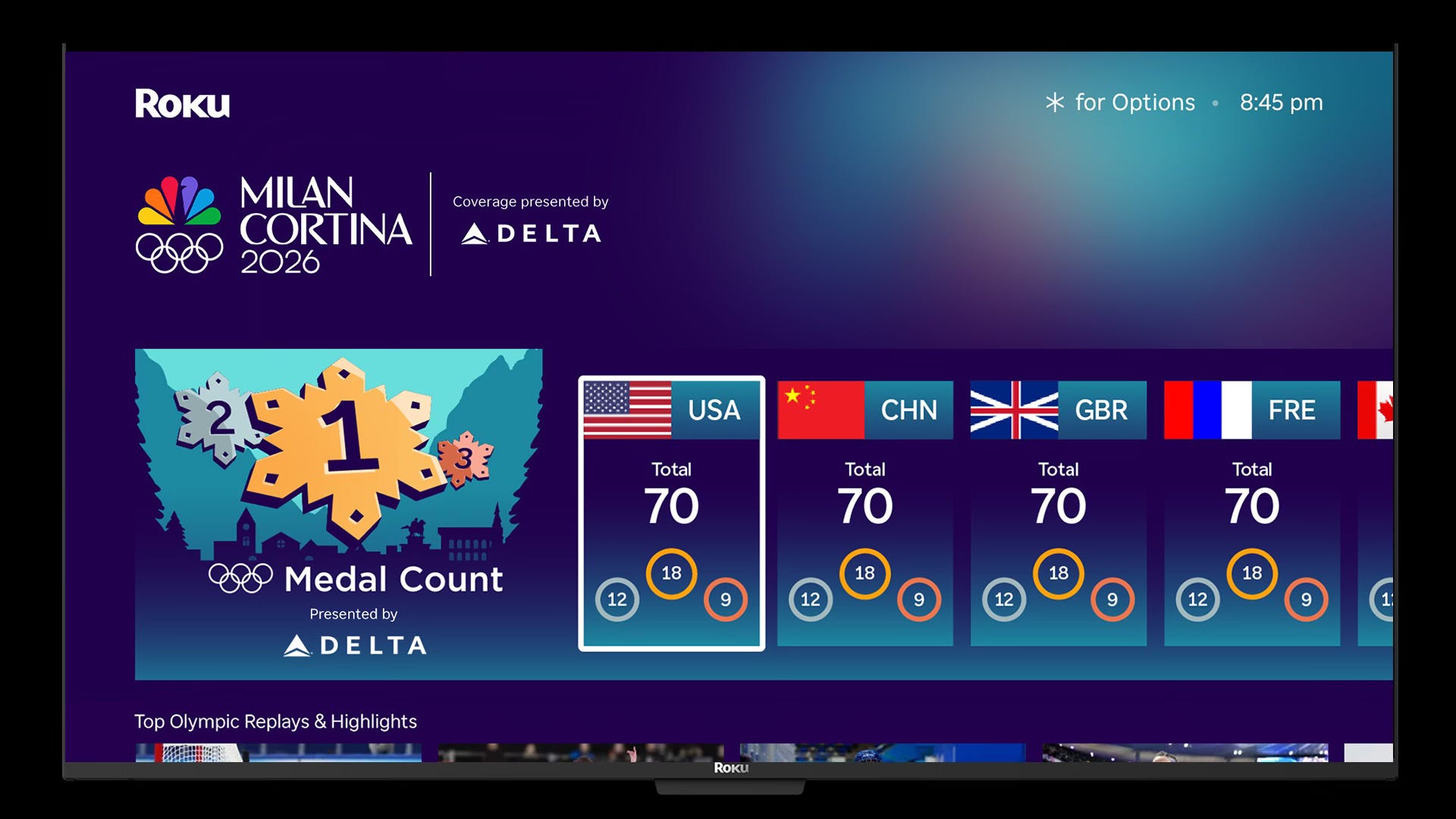
The most valuable single execution of the entire Olympics campaign belonged to Roku. NBCUniversal and Roku launched a dedicated 2026 NBC Winter Olympics Experience, a US-exclusive hub centralising NBC broadcast coverage and Peacock streaming for the Milan Cortina Games in one place. On the Roku Sports Zone page, a takeover promotion dominated the top of the page with bold Milan Cortina 2026 branding and Olympic iconography, intercepting high-intent sports viewers at the exact moment they arrived. A second placement inside the dedicated Olympics hub delivered a fully branded environment with structured event modules, live scheduling, and clear tune-in signposting, reducing navigation friction while keeping both NBC and Peacock front of mind throughout the Games.
Together these two Roku placements were the highest-value executions of the entire Olympics campaign, pairing top-of-page dominance with a sustained destination experience that kept viewers coming back across the full 17-day window.
The campaigns’ visuals, placement values and impression data are in the Looper Insights report. Download it here.
What this means if you are not NBCUniversal
This is US data on US platforms but the mechanics are universal and the stakes in Europe are rising fast. The placement economics on Samsung and other CTV platforms work the same way. What changes is the competitive context, the regulatory framework and the budget reality.
European broadcasters fight hard for app-level prominence on CTV platforms, backed by regulatory frameworks that should guarantee a seat at the table. What those frameworks do not guarantee is that anyone clicks. Legal prominence gives national services a visible position on the home screen. Paid visibility still decides who captures the moment when a viewer is actively deciding what to watch.

The question for every European broadcaster and streamer is not whether the home screen is a pay-to-play environment, because it already is, but whether they are investing accordingly.
That’s it for today. Comments, shares or likes come a long way 🙏🏻
In our next edition: HBO Max launches in the UK on March 26, completing Warner Bros. Discovery’s European rollout after years of Sky exclusivity. A new entrant on one of the most contested home screens in Europe with The Pitt, Euphoria Season 3 and TNT Sports as its opening hand. We will track how the launch campaign plays out across UK CTV platforms: where the app lands, what content leads the promotion and whether the placement strategy matches the ambition.
Enjoy your weekend and see you next week for another edition of Streaming Made Easy!
I'd be interested in your thoughts on the UKs freely platform. Your correct who owns the platform and landing screen wins and this is were freely really changes the dynamics.
In the UK most TV manufacturers will be install freely buy default. This means the home screen is really controlled by the UK core broadcaster eg BBC,.ITV etc...so your correct to get other services unless they agree to integrate with freely you need to open up there app.
So long term the owner of the platform on the TV and those who own the IP to the shows are really the winners
Now if Freely gets licensed to France / Germany etc...They could decide to make there local channels have the priority. That could impact Netflix etc... visibility